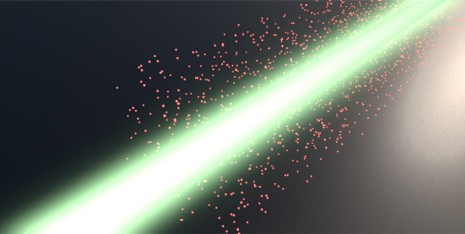
Pulsed lasers: the key to analysing gases quickly and precisely. (Image: ETH Zurich/Sandro Link)
Gases in the environment can be spectroscopically probed fast and precisely using so-called dual frequency combs. Researchers at ETH have now developed a method by which such frequency combs can be created much more simply and cheaply than before. In contrast to the light emitted by a simple lamp, laser light has a very precisely defined frequency. This makes it ideally suited to spectroscopic investigations, in which the properties of substances are determined on the basis of the frequencies at which they absorb light. A complete spectroscopic analysis typically requires a little patience, as the frequency of the laser has to be gradually changed ('scanned') in order to obtain a full spectrogram. A group of physicists at ETH in Zurich led by Ursula Keller at the Institute for Quantum Electronics have now demonstrated a seminal method that could lead to simpler and faster spectroscopic investigations in the future. For that purpose, they developed a novel technique for creating so-called dual frequency combs.
TO READ THIS ARTICLE, CREATE YOUR ACCOUNT
And extend your reading, free of charge and with no commitment.