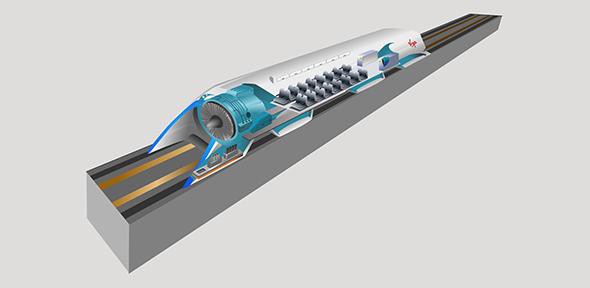
Concept art of Hyperloop inner works
Credit: Camilo Sanchez
Trains are getting increasingly faster, but as Professor Hugh Hunt from the Department of Engineering explains, the 'super-fast hyperloop' could soon see them matching air travel fo speed. Across Europe and parts of Asia, travellers can enjoy some of the fastest rail services in the world. From Málaga to Madrid, Tokyo to Osaka, high-speed electric trains condense the travel times between major hubs by racing along at some 300kph. The fastest commercial service in the world is the Shanghai maglev - short for magnetic levitation, the method of propulsion it uses to glide along its tracks as rapidly as 430kph. Of course, air travel is still much faster: an Airbus A380 aircraft has a cruising speed of over 1,000kph. But at a time when reducing emissions is a top priority across the globe, there's an urgent demand for cleaner, more energy-efficient alternatives - especially in the US, which is by far the world's biggest user of air travel , with almost 800m passengers each year. Enter, the Hyperloop - a train-like technology which has the potential to match air travel for speed.
TO READ THIS ARTICLE, CREATE YOUR ACCOUNT
And extend your reading, free of charge and with no commitment.