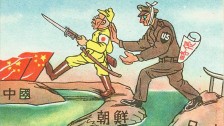
Cartoon produced as state propaganda in China during the 1950s Credit: Center for Research Libraries in Chicago
—Dr Barak Kushner - Barack Obama's resolution to kick off foreign policy for his second term with a tour of the Asia-Pacific region, at the end of 2012, was testimony not only to that area's growing economic importance, but also to the increasing significance of its politics. East Asia, Southeast Asia and the disputed China Seas now comprise the theatre in which the world's two superpowers meet. In the eyes of many, it is there that key decisions about supremacy, ideology - perhaps world politics as a whole - will, in future years, be made. In the West, China's rise is the subject of constant media analysis and it has almost become de rigueur to ask ourselves how well we really understand this new giant of the world stage. But as America begins to 'pivot' eastwards, by striking deals with China's neighbours, perhaps it is as important to question how much we understand East Asia as a whole. Do we really know what drives the world view of South Korea, or Taiwan, for example? And given the growing importance of that theatre, how effective is our grasp of how these countries view one another? Historically, the emergence (and re-emergence) of these nations after World War II is a surprisingly neglected topic. Many people are only vaguely aware that, until 1945, many parts of China, along with Taiwan, the Koreas and sections of Indochina, were at various times part of an expanding Japanese Empire that began in 1895.
TO READ THIS ARTICLE, CREATE YOUR ACCOUNT
And extend your reading, free of charge and with no commitment.