

Health - Today
Cortical thickness, schizophrenia, and causality in psychiatry: when the trace is mistaken for the cause
Cortical thickness, schizophrenia, and causality in psychiatry: when the trace is mistaken for the cause
Career - Today
Low-income students and girls are steered away from 'risky' creative careers at school
Low-income students and girls are steered away from 'risky' creative careers at school



Environment - Today
UCalgary expedition, with NASA, Canadian and European space agencies, sets out to better understand state of Arctic ice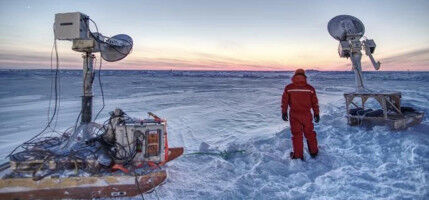
UCalgary expedition, with NASA, Canadian and European space agencies, sets out to better understand state of Arctic ice

Social Sciences - Mar 24
Young people's wellbeing is improving in Greater Manchester, major survey finds
Young people's wellbeing is improving in Greater Manchester, major survey finds

Environment - Mar 24
Australia's environment is improving but climate change is 'accelerating' damage to ecosystems and wildlife
Australia's environment is improving but climate change is 'accelerating' damage to ecosystems and wildlife

Psychology - Mar 23
The grief myth: it doesn't come in stages or follow a checklist - like love, it endures
The grief myth: it doesn't come in stages or follow a checklist - like love, it endures





History & Archeology - Mar 23
The UV has played a part in the discovery of a 3,500-year-old loom that sheds light on key aspects of the Bronze Age textile revolution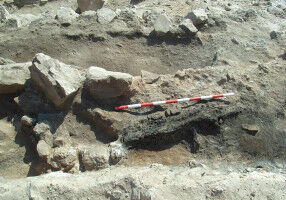
The UV has played a part in the discovery of a 3,500-year-old loom that sheds light on key aspects of the Bronze Age textile revolution

science wire
Paleontology
Results 1 - 50 of 156.
Paleontology - Research Management - 02.03.2026
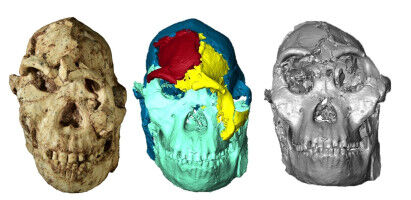
Identified as the most complete Australopithecus fossil discovered to date 1 , "Little Foot" was buried in sediments whose movement and weight caused fractures and deformations, making analysis of its skull-and more particularly its face-difficult.
Paleontology - Environment - 30.01.2026
Baby dinosaurs a common prey for Late Jurassic predators
Babies and very young sauropods - the long-necked, long-tailed plant-eaters that in adulthood were the largest animals to have ever walked on land - were a key food sustaining predators in the Late Jurassic, according to a new study led by a UCL researcher. The study, published in the New Mexico Museum of Natural History and Science Bulletin , used data from fossils laid down 150 million years ago in the Morrison Formation*, in the United States, to map out a "food web" of the time - a gigantic network of who ate what and who ate whom.
Environment - Paleontology - 29.01.2026
Uncover the origins of the genus Homo
Environment - Paleontology - 20.01.2026
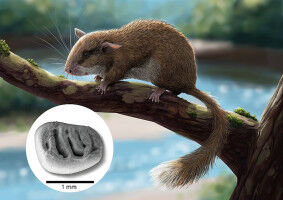
Very few know of them, fewer still have seen them in their natural environment, not least because today only one species of the spiny dormouse survives, in southern India.
Paleontology - Earth Sciences - 20.01.2026
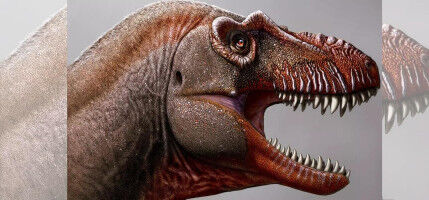
The science of dinosaurs has everyone - from students to Slash from Guns N' Roses - wanting to learn more about Earth's prehistoric population On the main floor of the Earth Sciences building at the University of Calgary, across from the Gallagher Library, sits an empty display case.
Paleontology - Earth Sciences - 07.01.2026
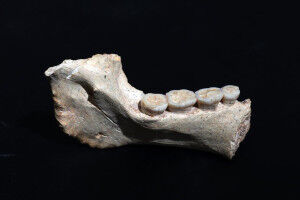
773,000-year-old fossils from Thomas Quarry I in Morocco illuminate the shared ancestry of Homo sapiens , Neandertals, and Denisovans Precisely dated fossils: A high-resolution magnetostratigraphic r
Life Sciences - Paleontology - 07.01.2026
Analysis: A speeding clock could solve Darwin’s mystery of gaps in animal fossil records
Professor Max Telford (UCL Biosciences) examines how the earliest fossils of complex animals, which appeared suddenly in rocks that were 538 million years old, evolved.
Environment - Paleontology - 05.01.2026
Opinion: Top climate books to look out for in 2026 - recommended by experts
Paleontology - Earth Sciences - 05.12.2025
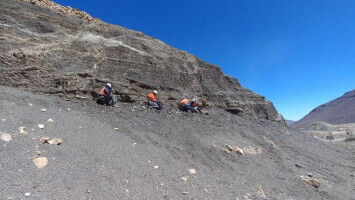
An unusually rich fossil deposit has been discovered and described by an international research team in the Atacama Desert in northern Chile.
Paleontology - Life Sciences - 12.11.2025
New species of fungus in 407-million-year-old plant fossil from Scotland
An ancient plant-fungus partnership has been revealed using advanced microscopy imaging, providing evidence of the mutually beneficial relationship that enabled plants to adapt to life on land. Our new technique is opening an exciting new window on life's earliest chapters. Raymond Wightman Researchers from the University of Cambridge and the Natural History Museum, London have identified a new species of ancient symbiotic fungus preserved within a 407-million-year-old plant fossil from Scotland.
Paleontology - 30.10.2025
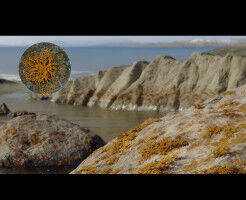
Lichens were already widespread over 410 million years ago, according to a new international study which identifies a fossil from Brazil as one of the oldest lichen in Earth's history. The team used cutting-edge x-ray imaging and other modern techniques to examine a fossil known as Spongiophyton , from the Devonian time period (around 419.2 to 358.9 million years ago).
Environment - Paleontology - 28.10.2025
Fossil giant snail reveals what European summer may look like in distant future
45 million years ago, Western Europe, influenced by high CO2 concentrations, had a warm and wet climate with monsoon-like conditions.
Music - Paleontology - 27.10.2025
Marco Brandazza - Between science and sound
His retirement in fall 2025 marks the end of a formative chapter in Swiss organ research. From oil to the organ When Marco Brandazza talks about his career, he covers a wide range of topics, from the rock strata of the Italian Riviera to the pipes and windchests of central Switzerland.
Paleontology - Earth Sciences - 14.10.2025

Further excavations at Oxfordshire-s -dinosaur highwaycontinued this summer to uncover Europe-s longest sauropod dinosaur trackway.
Paleontology - Life Sciences - 10.10.2025
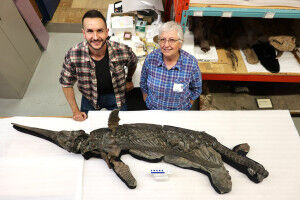
A near-complete skeleton found on UK's Jurassic Coast has been identified as a new and rare species of ichthyosaur - a type of prehistoric marine reptile that once ruled the ancient oceans. The dolphin-sized ichthyosaur called Xiphodracon goldencapensis , or the "Sword Dragon of Dorset" is the only known example of its kind in existence and helps to fill an important gap in the evolutionary fossil record of ichthyosaurs.
Paleontology - Physics - 02.10.2025
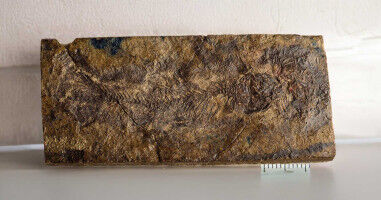
The fossil of a tiny fish found in southwestern Alberta provides new insight into the origin and evolution of otophysans, the supergroup of fish that includes catfish, carp and tetras, which today account for two-thirds of all freshwater species.
Paleontology - Life Sciences - 15.08.2025
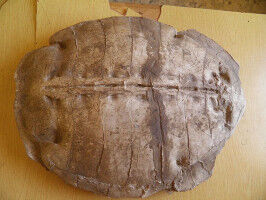
Near the Syrian city of Afrin, an international research team, including researchers from the Senckenberg Centre for Human Evolution and Palaeoenvironment at the University of Tübingen, has discovered a previously unknown fossil sea turtle.
Paleontology - Environment - 18.07.2025

Study on the diet and behavior of dinosaurs in the Jurassic period published / Researchers examined wear marks on fossil teeth What did long-necked dinosaurs eat - and where did they roam to satisfy their hunger?
Paleontology - Environment - 18.06.2025
How pterosaurs learned to fly: scientists have been looking in the wrong place to solve thi
Comment: How pterosaurs learned to fly: scientists have been looking in the wrong place to solve thi Writing in The Conversation, Dr Alfio Alessandro Chiarenza (UCL Earth Sciences) explains how climate, ecology and evolutionary science have come together to reveal how pterosaurs learned to fly.
Paleontology - Environment - 06.05.2025

Tyrannosaurus rex evolved in North America, but its direct ancestor came from Asia, crossing a land bridge connecting the continents more than 70 million years ago, according to a new study led by UCL researchers.
Paleontology - 25.03.2025

To the point Difference between humans, chimpanzees and Neanderthals: In humans, facial growth slows during childhood and stops during adolescence. Decline in bone cell activity: During puberty, the activity of the skull bone cells comes to a halt. This helps to keep the face smaller in adulthood. The human face is strikingly distinct from our fossil cousins and ancestors - most notably, it is significantly smaller, and more gracile.
Paleontology - 24.03.2025
How a catastrophe rewrote the history of Earth: VUB research premieres at Docville
Paleontology - Environment - 20.03.2025

Guy Plint is no stranger to tracking prehistoric beasts.
Paleontology - History & Archeology - 12.03.2025

The discovery of a human facial fragment aged over one million years represents the oldest known face in western Europe and confirms the region was inhabited by two species of human during the early Pleistocene, finds a new study involving a UCL researcher. The discovery of a human facial fragment aged over one million years represents the oldest known face in western Europe and confirms the region was inhabited by two species of human during the early Pleistocene, finds a new study involving a UCL researcher.
Life Sciences - Paleontology - 31.01.2025

History & Archeology - Paleontology - 29.01.2025
Hand axes that may go back 1,5 million years ago in Iraqi desert
Paleontology - Life Sciences - 23.01.2025

The remains of the earliest dinosaurs may lie undiscovered in the Amazon and other equatorial regions of South America and Africa, suggests a new study led by UCL researchers. Currently, the oldest known dinosaur fossils date back about 230 million years and were unearthed further south in places including Brazil, Argentina and Zimbabwe.
Paleontology - Social Sciences - 07.01.2025

How and when did dinosaurs first emerge and spread across the planet more than 200 million years ago? That question has for decades been a source of debate among paleontologists faced with fragmented fossil records. The mainstream view has held that the reptiles emerged on the southern portion of the ancient supercontinent Pangea called Gondwana millions of years before spreading to the northern half named Laurasia.
Paleontology - Earth Sciences - 02.01.2025

Researchers from the Universities of Oxford and Birmingham have uncovered a huge expanse of quarry floor filled with hundreds of different dinosaur footprints.
Paleontology - Earth Sciences - 18.12.2024

New research has provided fresh insights into the dramatic events surrounding the extinction of the dinosaurs 66 million years ago. The extinction of the Dinosaur was a tumultuous time that included some of the largest volcanic eruptions in Earth's history, as well as the impact of a 10-15 km wide asteroid.
Life Sciences - Paleontology - 04.12.2024

To better understand how modern human brains work, one ANU expert is using cutting-edge technology to study skulls from our ancient ancestors.
Paleontology - Environment - 19.11.2024
Saskatchewan’s first Centrosaurus and Citipes elegans fossils discovered by McGill researchers
Findings reveal rich dinosaur fauna on the edge of an ancient sea at a time of rising sea levels and a changing environment about 75 million years ago, researchers say Paleontologists and students from McGill University have documented Saskatchewan's first confirmed fossil specimens of Centrosaurus , a horned dinosaur species closely related to Triceratops .
Life Sciences - Paleontology - 12.11.2024

Using a particle accelerator, a scientific team has identified a new species of these fish, considered to be 'living fossils'.
Paleontology - Earth Sciences - 29.10.2024

Ancient "gold" bug fossils, infused with pyrite, have been identified as a new species of arthropod.
Earth Sciences - Paleontology - 06.09.2024

Writing in The Conversation, Professor Graham Sheilds and Elias Rugen (both UCL Earth Sciences) discuss their discovery of rocks proving the polar ice caps once expanded so far they joined up around the equator. More than 700 million years ago, the Earth was plunged into a state that geologists call "snowball Earth" , when our planet was entirely encased in ice.
Life Sciences - Paleontology - 09.08.2024
What Ancient Bones Can Tell Us: Exploring the Fossilized Past with Julia Tejada
Paleontology - 17.07.2024
Results of initiatives on fossil industry cooperation
TU Delft is committed to supporting the energy transition and seeks to collaborate with partners who endorse this mission.
Paleontology - 08.05.2024

A short but robust little shrimp may have died out over 330 million years ago during the Carboniferous period, but the rare Scottish shellfish has been revitalised as a new species to science and as a Glaswegian.
Paleontology - Life Sciences - 17.04.2024
Manchester paleontologist unearths what may be the largest known marine reptile
Part of the research team in 2020 examining the initial finds (at the back) of the new discovery made by Ruby and Justin Reynolds. Additional sections of the bone were subsequently discovered. From left to right, Dr Dean Lomax, Ruby Reynolds, Justin Reynolds and Paul de la Salle. Credit: Dr Dean Lomax A palaeontologist at The University of Manchester has identified the fossilised remains of a second gigantic jawbone measuring more than two metres long.
Paleontology - Life Sciences - 18.03.2024

Paleontology - Art & Design - 11.03.2024

Paleontology - Life Sciences - 05.03.2024

The oceans were full of large apex predators 66 million years ago, in contrast to modern times.
Life Sciences - Paleontology - 19.02.2024

New species of duckbill dinosaur found in Africa indicates they were diverse, with at least three species inhabiting north Africa at the end of the Cretaceous.
Environment - Paleontology - 07.02.2024

The last time atmospheric carbon dioxide consistently reached today's human-driven levels was 14 million years ago, researchers have found.
Paleontology - 22.01.2024

Paleontology - Media - 28.11.2023

Helioscopus dickersonae lived in North America in the late Jurassic period, 100 million years earlier than any previously known early gecko relative.
Paleontology - Earth Sciences - 06.11.2023

Yale paleontologists have identified a -problematic- fossil as an ancient sea creature that lived in the plankton 420 million years ago. The mystery of Ezekiel's Wheel - the extinct sea creature, not the Biblical vision - may have taken its final turn, thanks to Yale paleontologists. In so doing, the researchers have also finally put a scientific name to the favorite fossil of a beloved amateur fossil hunter.
Environment - Paleontology - 30.10.2023
Elephants: Earth’s giant climate change canaries
Research project traces 60 million years of elephant evolution and how humans may be the species' undoing University of Michigan researcher Bill Sanders poses with a newly discovered skull and skeleton of a palaeoloxodont elephant, which is about 1.2 million years old.
Paleontology - Art & Design - 24.10.2023
Manchester palaeontologist to hit Hollywood red carpet ahead of lead role in international dinosaur documentary
Earth Sciences - Paleontology - 23.10.2023

Geologists have long known that around 155 million years ago, a 5000 km long piece of continent broke off western Australia and drifted away.


Health - Today
Cortical thickness, schizophrenia, and causality in psychiatry: when the trace is mistaken for the cause
Cortical thickness, schizophrenia, and causality in psychiatry: when the trace is mistaken for the cause
Career - Today
Low-income students and girls are steered away from 'risky' creative careers at school
Low-income students and girls are steered away from 'risky' creative careers at school
Environment - Today
UCalgary expedition, with NASA, Canadian and European space agencies, sets out to better understand state of Arctic ice
UCalgary expedition, with NASA, Canadian and European space agencies, sets out to better understand state of Arctic ice
Social Sciences - Mar 24
Young people's wellbeing is improving in Greater Manchester, major survey finds
Young people's wellbeing is improving in Greater Manchester, major survey finds
Environment - Mar 24
Australia's environment is improving but climate change is 'accelerating' damage to ecosystems and wildlife
Australia's environment is improving but climate change is 'accelerating' damage to ecosystems and wildlife
Psychology - Mar 23
The grief myth: it doesn't come in stages or follow a checklist - like love, it endures
The grief myth: it doesn't come in stages or follow a checklist - like love, it endures
History & Archeology - Mar 23
The UV has played a part in the discovery of a 3,500-year-old loom that sheds light on key aspects of the Bronze Age textile revolution
The UV has played a part in the discovery of a 3,500-year-old loom that sheds light on key aspects of the Bronze Age textile revolution