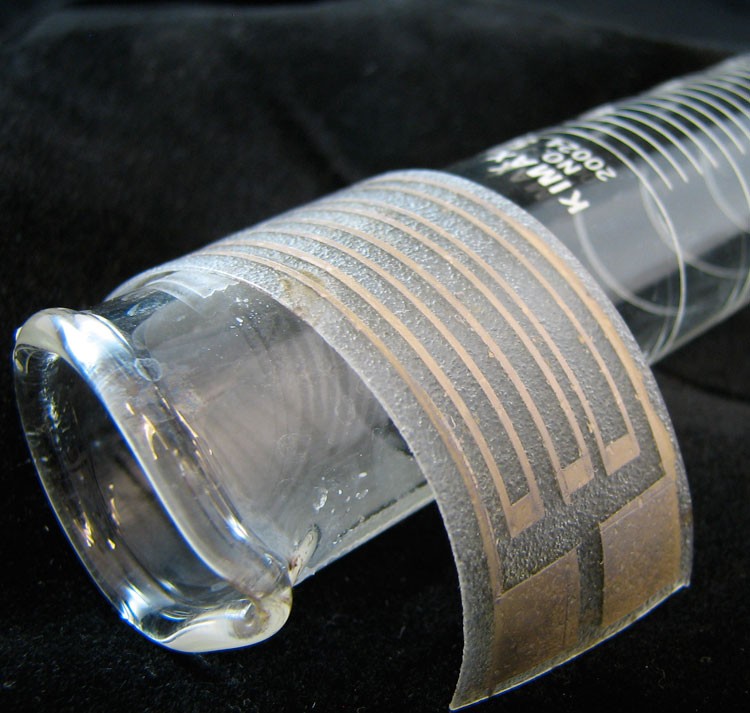
Reactive silver ink is airbrushed onto a thin, stretchy plastic film to make a flexible silver electrode.
CHAMPAIGN, Ill. University of Illinois materials scientists have developed a new reactive silver ink for printing high-performance electronics on ubiquitous, low-cost materials such as flexible plastic, paper or fabric substrates. Jennifer Lewis, the Hans Thurnauer Professor of Materials Science and Engineering, and graduate student S. Brett Walker described the new ink in the Journal of the American Chemical Society. "We are really excited about the wide applicability and excellent electrical properties of this new silver ink," said Lewis, the director of the Frederick Seitz Materials Research Laboratory at the U. of I. Electronics printed on low-cost, flexible materials hold promise for antennas, batteries, sensors, solar energy, wearable devices and more. Most conductive inks rely on tiny metal particles suspended in the ink. The new ink is a transparent solution of silver acetate and ammonia. The silver remains dissolved in the solution until it is printed, and the liquid evaporates, yielding conductive features.
TO READ THIS ARTICLE, CREATE YOUR ACCOUNT
And extend your reading, free of charge and with no commitment.