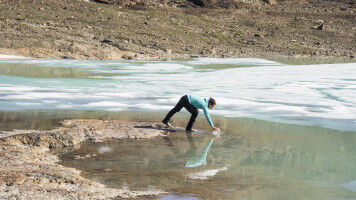
At Athabasca Glacier Tricia Stadnyk
At Athabasca Glacier Tricia Stadnyk Both the severity and length of droughts are increasing in western North America, including the prairies as well as parts of Africa, says a recent study published in Nature Climate Change. The study, authored by Dr. Tricia Stadnyk, PEng, PhD, professor of civil engineering in the Schulich School of Engineering and geography in the Faculty of Arts, and master's student Michael Vieira, used global climate models to predict some alarming hydrology trends around the world. "It's reinforcing the sentiment that the wet regions are getting wetter, and the dry are getting drier," says Stadnyk, the NSERC Tier 2 Canada Research Chair in Hydrological Modelling. An evaporation pan, which is how they measure changes in water loss from the surface and look for long-term changes in drought risk. Tricia Stadnyk - "What really emerged more clearly in th is study is there are certain parts of the Northern Hemisphere, specifically the Canadian prairies, that are getting drier and not just a little bit drier, but mean annual runoff was actually decreasing," she says. " D roughts are becoming more frequent, and the duration of those droughts is getting longer." Newer climate models have finer spatial resolution, improved representation of land surface hydrology and the ability to produce centuries-long simulations, which means they are better able to provide "meaningful information" about water. This most severe classification of drought, called "meteorological drought," can continue for so long that a region is no longer able to produce food it once could.
TO READ THIS ARTICLE, CREATE YOUR ACCOUNT
And extend your reading, free of charge and with no commitment.