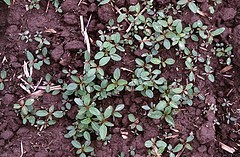
Credit: USDA Early growth stage of water-hemp, a weed that is becoming resistant to certain herbicides.
Town Hall Forum video posted Board executive committee reaffirms, ratifies earlier decisions Students host fundraiser to benefit abused children Penn State, PA Coalition Against Rape join to fight child sexual abuse Penn State Town Hall Forum provides open discussion UNIVERSITY PARK, Pa. Weeds that have become resistant to glyphosate - the active ingredient in Round-Up herbicide - are an evolving national threat. At least three glyphosate-resistant species are approaching Pennsylvania, necessitating new strategies for weed control, according to a Penn State College of Agricultural Sciences specialist. Dwight Lingenfelter, Penn State Extension weed scientist, said. Glyphosate-based herbicide programs routinely controlled these weeds, but now the effectiveness of those programs is dwindling. "There's a species called Palmer pigweed or Palmer amaranth, which is a huge problem - especially in cotton-growing regions," said Lingenfelter. "In the past, farmers were spending only maybe $20 to $30 an acre to control pigweed; now they're up over $90 to $100 an acre, because of its resistance to a number of herbicide modes of action." Currently, no major outbreaks of this weed exist in Pennsylvania, but reports from Delaware and Maryland indicate it probably will creep into the Commonwealth's cropping systems, especially in southern Pennsylvania.
TO READ THIS ARTICLE, CREATE YOUR ACCOUNT
And extend your reading, free of charge and with no commitment.