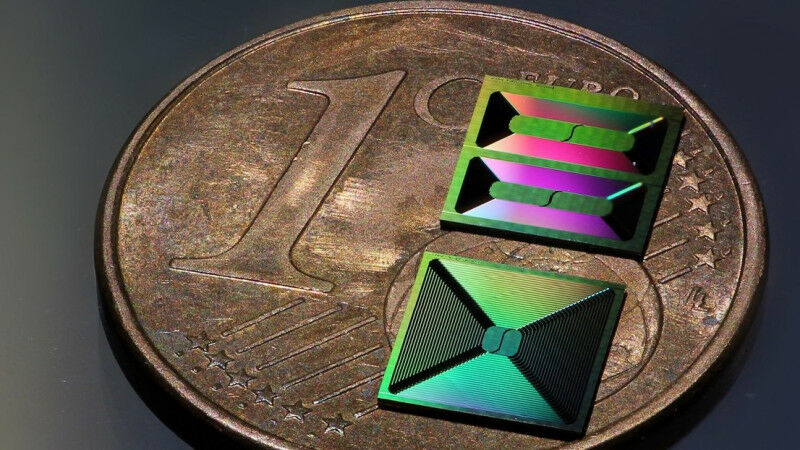
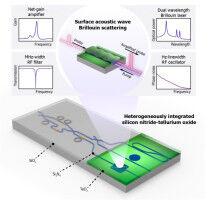
The photonic integrated circuits used in this study. Credit: Tobias Kippenberg (EPFL)
The photonic integrated circuits used in this study. Credit: Tobias Kippenberg (EPFL) - Scientists at EPFL have developed photonic integrated circuits that demonstrated a new principle of light amplification on a silicon chip. It can be employed for optical signals like those used in Lidar, trans-oceanic fiber amplifiers or in data center telecommunications. The ability to achieve quantum-limited amplification of optical signals contained in optical fibers is arguably among the most important technological advances that are underlying our modern information society. In optical telecommunications, the choice of 1550 nm wavelength band is motivated not only by loss minima of silica optical fibers (a development recognized with the 2008 Nobel Prize in Physics), but equally to the existence of ways to amplify these signals, crucial to achieve trans-oceanic fiber optical communication. Optical amplification plays a key role in virtually all laser-based technologies such as optical communication, used for instance in data-centers to communicate between servers and between continents through trans-oceanic fiber links, to ranging applications like coherent Frequency Modulated Continuous Wave (FMCW) LiDAR - an emerging technology that can detect and track objects farther, faster, and with greater precision than ever before. Today, optical amplifiers based on rare-earth ions like erbium, as well as III-V semiconductors, are widely used in real-world applications.
TO READ THIS ARTICLE, CREATE YOUR ACCOUNT
And extend your reading, free of charge and with no commitment.