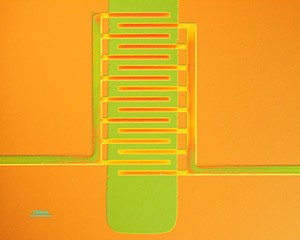
Princeton researchers have developed a new way to manufacture electronic devices made of plastic, employing a process that allows the materials to be formed into useful shapes while maintaining their ability to conduct electricity. In the plastic transistor pictured here, the plastic is molded into interdigitated electrodes (orange) allowing current flow to and from the active channel (green). (Image: Loo Research Group)
A new technique developed by Princeton University engineers for producing electricity-conducting plastics could dramatically lower the cost of manufacturing solar panels. By overcoming technical hurdles to producing plastics that are translucent, malleable and able to conduct electricity, the researchers have opened the door to broader use of the materials in a wide range of electrical devices. With mounting concerns about global warming and energy demand, plastics could represent a low-cost alternative to indium tin oxide (ITO), an expensive conducting material currently used in solar panels, according to the researchers. "Conductive polymers [plastics] have been around for a long time, but processing them to make something useful degraded their ability to conduct electricity," said Yueh-Lin Loo , an associate professor of chemical engineering , who led the Princeton team. "We have figured out how to avoid this trade-off. We can shape the plastics into a useful form while maintaining high conductivity." A multi-institutional team reported on its new technique in a paper published online March 8 in the Proceedings of the National Academy of Sciences. The area of research, known as "organic electronics" because plastics are carbon-based like living creatures, holds promise for producing new types of electronic devices and new ways of manufacturing existing technologies, but has been hampered by the mysterious loss of conductivity associated with moldable plastics.
TO READ THIS ARTICLE, CREATE YOUR ACCOUNT
And extend your reading, free of charge and with no commitment.