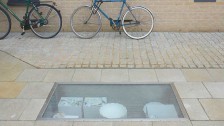
Edmund de Waal installation at CRASSH Credit: Joanne Underhill
The vitrines are meant to be happened upon as you come and go. They are there to make you pause momentarily." - —Edmund de Waal, artist and writer In daylight they are barely visible until you are almost upon them, a reminder perhaps of how much of our history lies underground and unseen, waiting to be uncovered; at night they shed a soft glow that invites you to look beneath your feet and marvel at their fragile strength. Potter and author Edmund de Waal's installation - three vitrines of porcelain set into the paving slabs on the threshold of one of Cambridge's newest humanities buildings - is typically understated. Beneath their glass lids, the enclosures contain dishes, pots and fragments, in the pale hues of porcelain with occasional flashes of gold. De Waal has described the installation, titled 'a local history', as an archive or palimpsest, terms that reflect the way in which his work draws on historic influences, the passing of time, fragility and enduringness, and the ability of the human hand to make the finest objects. By virtue of its subtle references to the human story and our fascination with producing and collecting things, 'a local history' also hints at the multi-disciplinary research taking place in the Alison Richard Building which is home to CRASSH (Centre for Research in the Arts, Social Sciences and Humanities), POLIS (Department of Politics and International Studies) and the major regional studies centres. Though de Waal has been producing ceramics for decades, the installation is his first commission of public art.
TO READ THIS ARTICLE, CREATE YOUR ACCOUNT
And extend your reading, free of charge and with no commitment.