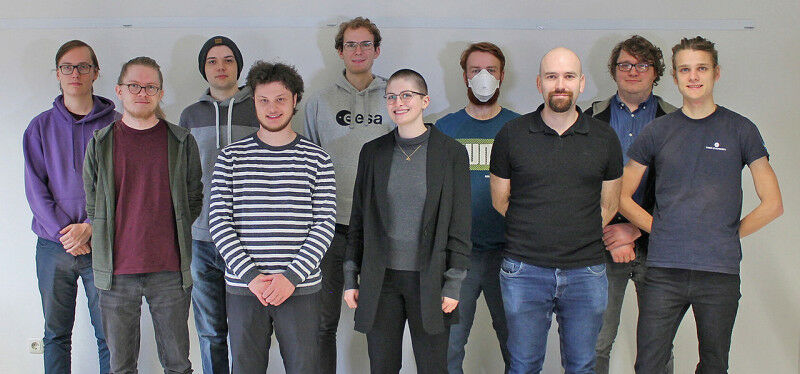
Some of the 20 students who are working independently on the KI-SENS project for more safety in small satellites.
Some of the 20 students who are working independently on the KI-SENS project for more safety in small satellites. Using artificial intelligence methods to prevent collisions of nanosatellites in orbit: This is the aim of a new project in which students are leading the pen. Small satellites with a mass of up to 20 kilograms are increasingly being used for commercial purposes, for example for telecommunications services, Earth observation missions or for testing new technologies in space. This entails risks: With the increasing number of small satellites, the probability of collisions in orbit increases. Students at Julius-Maximilians-Universität Würzburg (JMU) in Bavaria, Germany, want to prevent this danger. In the newly launched KI-SENS project, they are developing intelligent sensors and algorithms for small satellites so that they can detect dangerous approaches to other objects in good time and prevent collisions by changing course. Students get to know the entire process .
TO READ THIS ARTICLE, CREATE YOUR ACCOUNT
And extend your reading, free of charge and with no commitment.