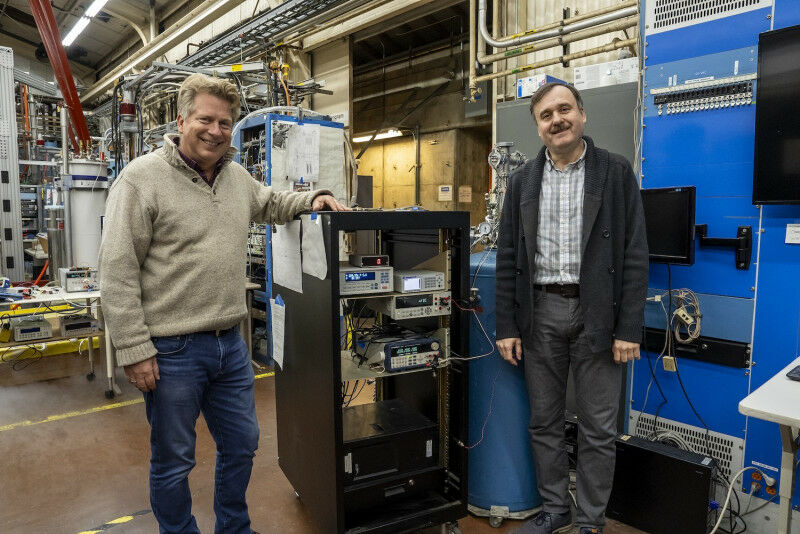
Soren Prestemon (left) and Maxim Marchevsky in the superconducting magnet test facility, where a wide variety of research experiments are performed in support of the development of next-generation magnet technology. (Credit: Marilyn Sargent/Berkeley Lab)
Soren Prestemon ( left ) and Maxim Marchevsky in the superconducting magnet test facility, where a wide variety of research experiments are performed in support of the development of next-generation magnet technology. (Credit: Marilyn Sargent/Berkeley Lab) - The particle accelerators that enable high energy physics and serve many fields of science, such as materials, medical, and fusion research, are driven by superconducting magnets that are, to put it simply, quite finicky. Superconductors are a special class of materials which, when cooled below a certain temperature, carry large electrical currents without resistance. If you arrange the material in coils, the current passing through will produce strong magnetic fields, effectively storing the potential energy of the moving electrons in the form of magnetic field. But if they get too hot - and by hot, we mean only a few degrees above -452 Fahrenheit (4. Kelvin), or the temperature of liquid helium - they can suddenly regain their electrical resistance and dissipate the energy of the magnetic field in a rapid burst of heat. A newer type of superconductor, known as high temperature superconductors (HTS), is poised to usher in another revolution for science and technology.
TO READ THIS ARTICLE, CREATE YOUR ACCOUNT
And extend your reading, free of charge and with no commitment.