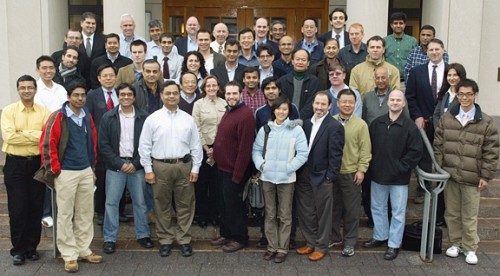
Princeton researchers are leading the Gigascale Systems Research Center, a consortium of 37 researchers across 15 universities that will search for ways to make computers more powerful, energy-efficient and reliable. (Photo: Frank Wojciechowski)
Princeton engineers are leading a research center that brings together scientists and engineers from multiple universities to determine how to improve the speed, reliability and energy-efficiency of tomorrow's computer systems while reducing their cost. The Gigascale Systems Research Center , a consortium of dozens of researchers across 15 universities, will focus on solving a range of technical hurdles that are emerging as computing demands strain the capabilities of current processor design technology. The scientists will explore new designs, programming techniques and applications of computing. "We are asking what computer processors will look like in 10 years and beyond, as well as how will they be programmed and what applications will they be used for," said Sharad Malik , the George Van Ness Lothrop Professor in Engineering at Princeton, who was named director of the center last fall. "This gives us the opportunity to come up with a fresh agenda, to try out creative ideas and take more risks." Princeton researchers are leading the Gigascale Systems Research Center, a consortium of 37 researchers across 15 universities that will search for ways to make computers more powerful, energy-efficient and reliable. (Photo: Frank Wojciechowski) The center is part of the Focus Center Research Program, a collection of six research centers that collectively receive about $40 million in funding from the federal government's Defense Advance Research Project Agency (DARPA) and a coalition of U.S. semiconductor, computer systems and defense companies, including IBM, Intel and Texas Instruments.
TO READ THIS ARTICLE, CREATE YOUR ACCOUNT
And extend your reading, free of charge and with no commitment.