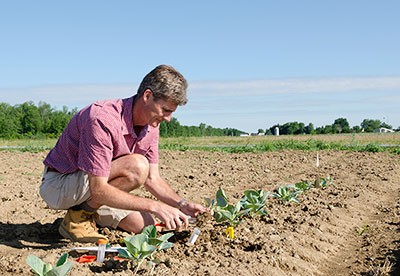
Thomas Björkman, assistant of horticulture, works with broccoli varieties adapted to the East Coast’s hot and humid summers.
Chefs and home cooks in the eastern U.S. could soon have easier access to a local "super food," thanks to a Cornell-led team of researchers working to expand broccoli's availability at farms, farmer's markets and grocery stores from Maine to Florida. Broccoli is at the center of a nearly $1 billion a year U.S. industry, due in part to growing awareness of its health benefits. Broccoli has anti-inflammatory properties, is high in fiber and has been linked with improving vitamin D deficiency and helping prevent certain cancers. Broccoli also contains phytonutrients that aid in detoxification, making it a fitting food for the New Year. But despite increasing consumption, 90 percent of broccoli sold in the East is produced in California and Mexico, resulting in more food miles, greater greenhouse gas emissions and profits that leave the region, according to Thomas Björkman, associate professor of horticulture in the College of Agriculture and Life Sciences who is based at the New York State Agricultural Experiment Station in Geneva, N.Y. Björkman is leading a team that includes researchers from public broccoli-breeding programs and private seed companies, production specialists and economists in building a regional food network for the vegetable. Their goal is to move production from isolated pockets to a year-round market worth $100 million a year. Two years into the project, which is funded by a $3.2 million U.S. Department of Agriculture grant and supplemented by $1.7 million in matching funds from participating companies, the goal looks to be within reach.
TO READ THIS ARTICLE, CREATE YOUR ACCOUNT
And extend your reading, free of charge and with no commitment.