Vesta, as seen by Dawn
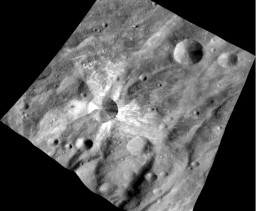
Like a movie star constantly retouching her makeup, the protoplanet Vesta is continually stirring its outermost layer and presenting a young face. New data from NASA's Dawn mission show that a common form of weathering that affects many airless bodies like Vesta in the inner solar system, including the moon, surprisingly doesn't age the protoplanet's outermost layer. The data also indicate that carbon-rich asteroids have been splattering dark material on Vesta's surface over a long span of the body's history. Over time, soils on the moon and on asteroids have undergone extensive weathering. Scientists see this in the accumulation of tiny metallic particles containing iron, which dulls the bright, fluffy outer layers of these bodies. Yet Dawn's visible and infrared mapping spectrometer (VIR) and framing camera detected no accumulation of these tiny particles on Vesta, and the protoplanet (sometimes called a giant asteroid) remains bright and pristine. Still, the bright rays of the youngest features on Vesta are seen to degrade rapidly and disappear into background soil.
TO READ THIS ARTICLE, CREATE YOUR ACCOUNT
And extend your reading, free of charge and with no commitment.