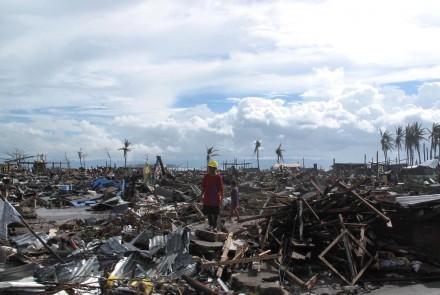
Photo by Henry Donati, UK Department for International Development.
A flying squad of public health specialists has been officially launched in Melbourne, bringing together Australia's best experts who can rush to emergencies and disasters around the country and the world to stop the spread of infectious disease. The group of specialist epidemiologists has already shown its value, with several experts sent to respond to Typhoon Haiyan in the Philippines in 2013, where they played a key role monitoring community's health and stopping epidemic-prone disease from spreading and killing more people. "The aftermath of a major disaster can often be a dangerous time," said the group's co-chair, Dr Martyn Kirk from the ANU National Centre for Epidemiology and Public Health. "People who have suffered one disaster can find themselves caught up in a disease outbreak with disastrous consequences, particularly if water, food and health supplies have been disrupted." After the 2010 Haiti earthquake, an outbreak of cholera killed more than 8,000 people. Dr Kirk said the new network provides a ready supply of highly qualified professionals to volunteer with early detection and response to epidemics of diseases such as cholera, hepatitis, influenza, malaria and dengue. The rapid-response network is a collaboration between the Australian National University, Sydney's University of New South Wales (UNSW), and Melbourne's Burnet Institute. Its members include doctors, nurses, veterinarians, scientists and public health officials from around Australia.
TO READ THIS ARTICLE, CREATE YOUR ACCOUNT
And extend your reading, free of charge and with no commitment.