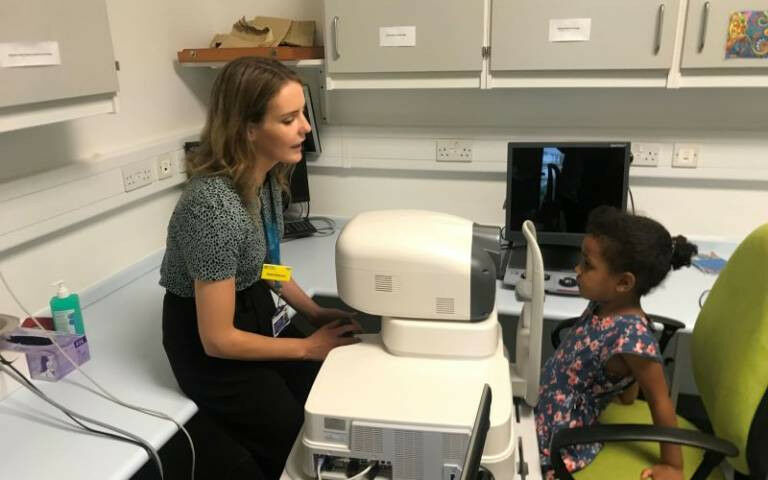
Child scanned for uveitis
Child scanned for uveitis - Members of the public are being asked to examine and evaluate high-resolution images of the potentially blinding eye condition, uveitis, as part of a UCL-led project aimed at ensuring children with the disease are diagnosed and treated far more quickly. The Eye on Eyes initiative is building up a bank of images from children with uveitis that need to be analysed and labelled by humans, so they can eventually be used to train artificial intelligence to detect the disease automatically. Participants will be asked to judge the quality of the images, annotate the images, or mark possible inflammatory cells inside the eye. Uveitis is a form of eye inflammation that can cause vision loss. It one of the most common reasons behind adult attendances to eye casualty clinics, but it is far less common in children, with around 3,000-5,000 children in the UK having the disorder. Explaining the problem of childhood uveitis, project lead Dr Lola Solebo (UCL Great Ormond Street Institute of Child Health and Honorary Consultant Ophthalmologist at Great Ormond Street Hospital), said: "Often children have difficulty making their eye problems known or can't feel that they have a problem until their condition has deteriorated. "As a result, they are more likely to need powerful medications, including tablets and muscle injections, to control their uveitis, as it tends to be more aggressive and likely to cause blindness.
TO READ THIS ARTICLE, CREATE YOUR ACCOUNT
And extend your reading, free of charge and with no commitment.