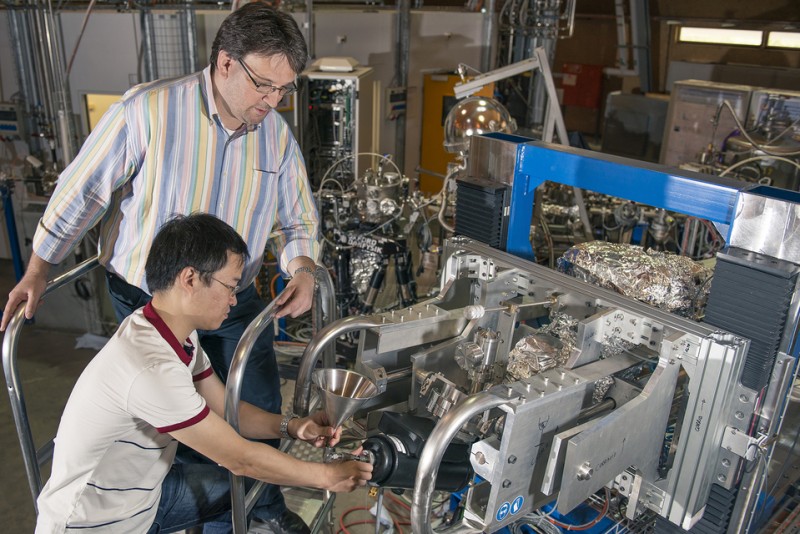
PSI researchers Thorsten Schmitt and Yaobo Huang at the ADRESS beamline at the SLS (Photo: Paul Scherrer Institute/Mahir Dzambegovic)
Media Releases Matter and Material Materials Research Research Using Synchrotron Light. New effect might be important for emergence of High-Temperature Superconductivity An international team of researchers from SLAC National Accelerator Laboratory and Stanford University (both California) and the Paul Scherrer Institute (Villigen, Switzerland) has observed a new, unexpected kind of behaviour in copper-based high-temperature superconductors - materials that are capable of conducting electric current without any loss when cooled to low enough temperatures. Explaining the new phenomenon - a new, unexpected form of collective movement of the electrical charges in the material - poses a major challenge for the researchers. A success in explaining the phenomenon might be an important step toward understanding high-temperature superconductivity in general. The crucial experiments were conducted at the Paul Scherrer Institute's Swiss Light Source. The results of this project have been published on 19 October 2014. Despite their name high-temperature superconductors have to be cooled heavily before they become superconducting.
TO READ THIS ARTICLE, CREATE YOUR ACCOUNT
And extend your reading, free of charge and with no commitment.