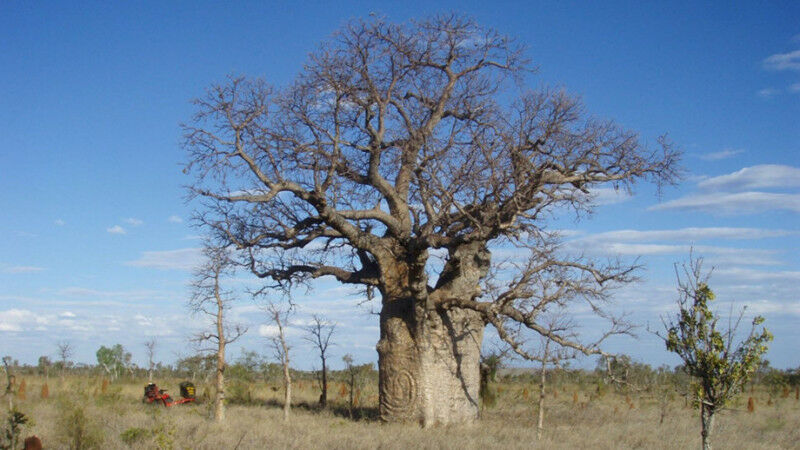
Carvings in boab trees are considered as significant as Indigenous rock art. Photo: Darrell Lewis.
Carvings in boab trees are considered as significant as Indigenous rock art. Photo: Darrell Lewis. Researchers are working with a group of First Nations Australians in a race against time to document ancient art in the bark of Australia's boab trees in some of the roughest terrain on Earth. Carvings in the boab trees tell the stories of the King Brown Snake (or Lingka) Dreaming in the Tanami Desert, which straddles the border of Western Australia and the Northern Territory. After more than two years of fieldwork, the research team from The Australian National University (ANU), University of Western Australia and University of Canberra, working alongside five Traditional Owners, found 12 trees with carvings. Professor Sue O'Connor, from the ANU School of Culture, History and Language, said many of the carved trees are already several hundreds of years old and there is some urgency to produce high-quality recordings before these remarkable heritage trees die. "Unlike most Australian trees, the inner wood of boabs is soft and fibrous and when the trees dies, they just collapse," Professor O'Connor said.
TO READ THIS ARTICLE, CREATE YOUR ACCOUNT
And extend your reading, free of charge and with no commitment.