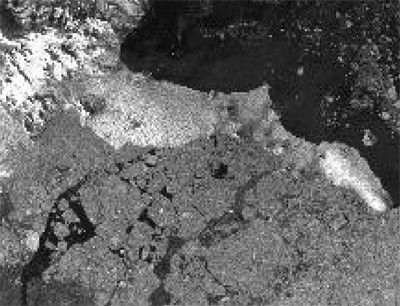
Das ASAR Bild zeigt das auseinanderbrechende Schelfeis in der Region zwischen Larsen-A und Larsen-B.
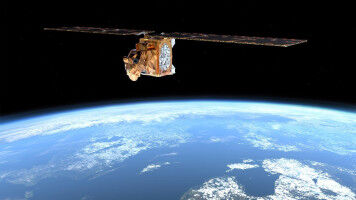
For ten years ESA's Envisat satellite observed the rapid retreat of one of Antarctica's ice shelves due to climate warming. Helmut Rott, Professor at the Institute of Meteorology and Geophysics, follows this development since the start of the mission. One of the satellite's first observations following its launch on 1 March 2002 was the break-up of a main section of the Larsen B ice shelf in Antarctica - when 3200 sq km of ice disintegrated within a few days due to mechanical instabilities of the ice masses triggered by climate warming. Now, with ten years of observations using its Advanced Synthetic Aperture Radar (ASAR), Envisat has mapped an additional loss in Larsen B's area of 1790 sq km over the past decade. The Larsen Ice Shelf is a series of three shelves - A (the smallest), B and C (the largest) - that extend from north to south along the eastern side of the Antarctic Peninsula. Larsen A disintegrated in January 1995. Larsen C so far has been stable in area, but satellite observations have shown thinning and an increasing duration of melt events in summer.
TO READ THIS ARTICLE, CREATE YOUR ACCOUNT
And extend your reading, free of charge and with no commitment.