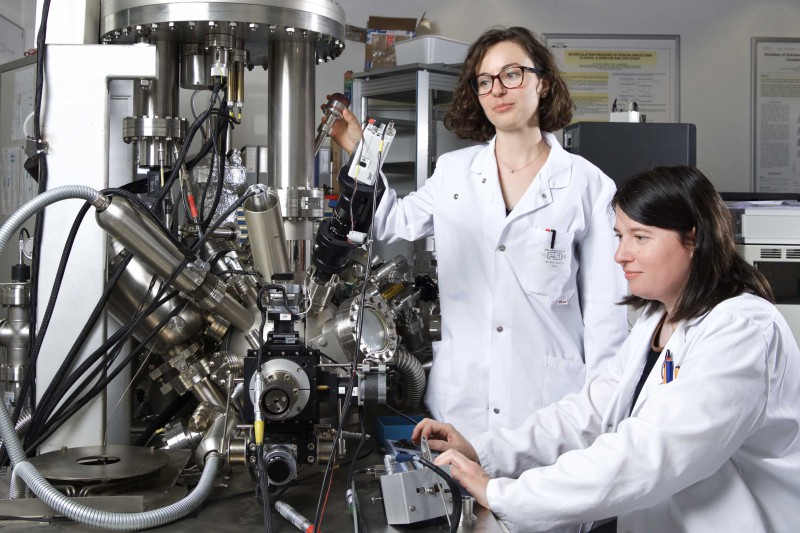
Juliette Billaud, co-first author of the new study, and Claire Villevieille, head of the battery materials research group at the Paul Scherrer Institute. (Photo: Markus Fischer/Paul Scherrer Institute)
Materials researchers at the Swiss Paul Scherrer Institute PSI in Villigen and the ETH Zurich have developed a very simple and cost-effective procedure for significantly enhancing the performance of conventional Li-ion rechargeable batteries. The procedure is scalable in size, so the use of rechargeable batteries will be optimized in all areas of application—whether in wristwatches, smartphones, laptops or cars. Battery storage capacity will be significantly extended, and charging times reduced. The researchers reported on their results in the latest issue of the research journal Nature Energy . It's not necessary to re-invent the rechargeable battery in order to improve its performance. As Claire Villevieille, head of the battery materials research group at the Paul Scherrer Institute PSI says: In the context of this competitive field, most researchers concentrate on the development of new materials. In cooperation with colleagues at the ETH in Zurich, Villevieille and co-researcher Juliette Billaud took a different approach: We checked existing components with a view to fully exploiting their potential.
TO READ THIS ARTICLE, CREATE YOUR ACCOUNT
And extend your reading, free of charge and with no commitment.