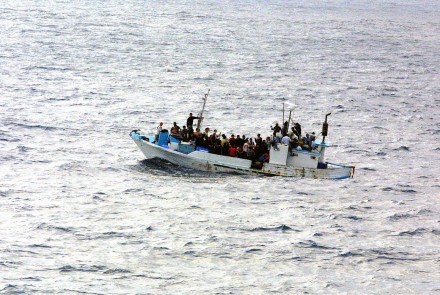
Refugees on a boat. (Photo by Defense Visual Information Center via Wikipedia)
A report released today by ANU reveals that policies aimed at deterring and deflecting refugees cannot be the basis of regional arrangements for refugee protection. In comparison to the 2012 Houston Expert Panel report, which recommended that Australia implement policies to deter refugees from coming to Australia, the report released by ANU today suggests that such policies are likely to undermine cooperation among states in the Asia Pacific region and run the real risk of harming refugees. The report is from the Colloquium on Refugees, Regionalism and Responsibility , which brought together more than 25 experts in law and refugee protection from Australia and around the world, and representatives of the UNHCR, Indonesia and the Association of Southeast Asian Nations Intergovernmental Commission on Human Rights. Professor Penelope Mathew , from the College of Arts and Social Sciences co-convened the Colloquium, and she said that responsibility sharing is imperative to enhance protection of refugees in the Asia Pacific region. "Developing countries host more than 80 per cent of the world's refugees and they are not adequately supported. More effort is required to ensure that refugees are able to work, pursue their education and contribute to their host societies," says Professor Mathew. Mr Richard Towle, the UNHCR Representative for Australia, New Zealand, Papua New Guinea and the Pacific spoke to those attending, saying that responsibility sharing needs to be based on principles of equity, respect for sovereignty, reciprocity and solidarity between states in addressing the protection needs of refugees.
TO READ THIS ARTICLE, CREATE YOUR ACCOUNT
And extend your reading, free of charge and with no commitment.