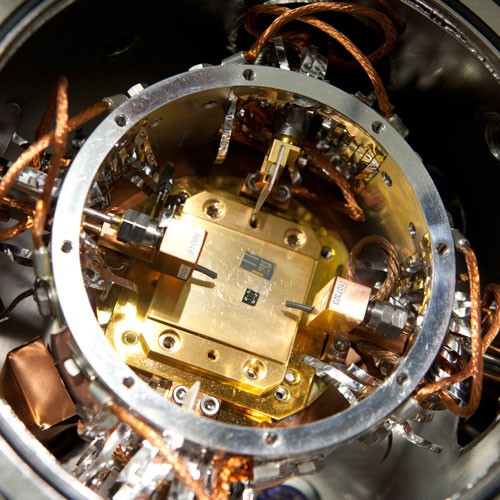
The chamber of the probe station where Donhee Ham’s research group tests the new metamaterials. (Photo by Eliza Grinnell, SEAS Communications.)
New technique using kinetic inductance shows promise for dramatic miniaturization of metamaterials. Caroline Perry , (617) 496-1351 In a vacuum, light travels so fast that it would circle the Earth more than seven times within the blink of an eye. When light propagates through matter, however, it slows by a factor typically less than 5. This factor, called the refractive index, is positive in naturally occurring materials, and it causes light to bend in a particular direction when it shines on, for example, water or glass. Over the past two decades, scientists have managed to create artificial materials whose refractive indices are negative; these negative-index metamaterials defy normal experience by bending light in the "wrong" direction. Due to their unusual ability to manipulate electromagnetic waves and their potential to be harnessed for technology (that might, for example, cloak objects from view), negative-index metamaterials have been celebrated by scientists and engineers alike. Researchers at the Harvard School of Engineering and Applied Sciences (SEAS), collaborating with the Weizmann Institute of Science in Israel, have now demonstrated a drastically new way of achieving negative refraction in a metamaterial.
TO READ THIS ARTICLE, CREATE YOUR ACCOUNT
And extend your reading, free of charge and with no commitment.