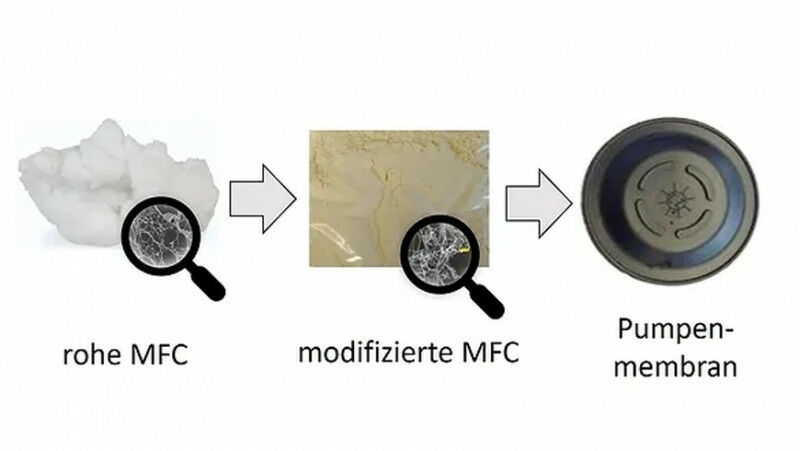
It is a challenge to blend microfibrillated cellulose (MFC) with hydrophobic, i.e. water-repellent, rubbers. Image: Empa / Daetwyler Schweiz AG
It is a challenge to blend microfibrillated cellulose (MFC) with hydrophobic, i.e. water-repellent, rubbers. Image: Empa / Daetwyler Schweiz AG - The substitution of petrochemical materials with those obtained from renewable raw materials is an important step towards increasing sustainability. In just two years of intensive and open collaboration between Empa and the Datwyler Schweiz AG as part of an Innosuisse project, a process was successfully developed that brought together the worlds of cellulose and rubbers. The substitution of petrochemical materials with those obtained from renewable raw materials is an important step towards increasing sustainability. Materials derived from plant cellulose are promising candidates for this application area. They are renewable, abundant and have a low environmental impact. In the rubber industry, microfibrillated cellulose (MFC) is receiving a lot of attention due to its high stiffness, the morphology of its fibrils, its low density and its mechanical properties.
TO READ THIS ARTICLE, CREATE YOUR ACCOUNT
And extend your reading, free of charge and with no commitment.