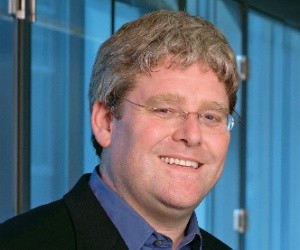
Christopher Murray
When University of Pennsylvania nanoscientists created beautiful, tiled patterns with flat nanocrystals, they were left with a mystery: why did some sets of crystals arrange themselves in an alternating, herringbone style, even though it wasn't the simplest pattern? To find out, they turned to experts in computer simulation at the University of Michigan and the Massachusetts Institute of Technology. The result gives nanotechnology researchers a new tool for controlling how objects one-millionth the size of a grain of sand arrange themselves into useful materials, it gives a means to discover the rules for "programming" them into desired configurations. The study was led by Christopher Murray, a professor with appointments in the Department of Chemistry in the School of Arts and Sciences and the Department of Materials Science and Engineering in the School of Engineering and Applied Sciences. Also on the Penn team were Cherie Kagan , a chemistry, MSE and electrical and systems engineering professor, and postdoctoral researchers Xingchen Ye, Jun Chen and Guozhong Xing. They collaborated with Sharon Glotzer , a professor of chemical engineering at Michigan, and Ju Li , a professor of nuclear science and engineering at MIT. Their research was featured on the cover of. "The excitement in this is not in the herringbone pattern," Murray said, "It's about the coupling of experiment and modeling and how that approach lets us take on a very hard problem." Previous work in Murray's group has been focused on creating nanocrystals and arranging them into larger crystal superstructures.
TO READ THIS ARTICLE, CREATE YOUR ACCOUNT
And extend your reading, free of charge and with no commitment.