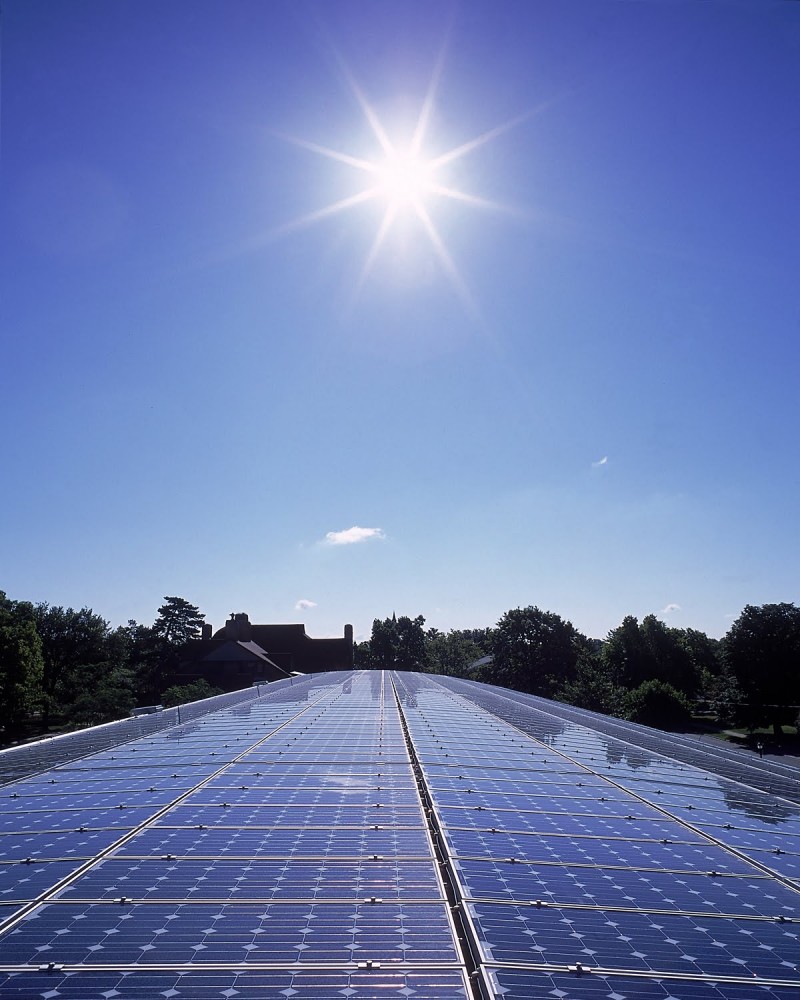
Contrary to conventional scientific wisdom, the key to solar cell efficiency is not absorbing more photons but emitting more photons. (Image courtesy of DOE NREL)
Theoretical research by scientists with the U.S. Department of Energy (DOE)'s Lawrence Berkeley National Laboratory (Berkeley Lab) has led to record-breaking sunlight-to-electricity conversion efficiencies in solar cells. The researchers showed that, contrary to conventional scientific wisdom, the key to boosting solar cell efficiency is not absorbing more photons but emitting more photons. "A great solar cell also needs to be a great Light Emitting Diode," says Eli Yablonovitch, the Berkeley Lab electrical engineer who led this research. "This is counter-intuitive. Why should a solar cell be emitting photons? What we demonstrated is that the better a solar cell is at emitting photons, the higher its voltage and the greater the efficiency it can produce." Yablonovitch holds joint appointments with Berkeley Lab's Materials Sciences Division and the University of California (UC) Berkeley, where he is the James and Katherine Lau Chair in Engineering, and also directs the NSF Center for Energy Efficient Electronics Science. He is the corresponding author of a paper describing this work titled "Intense Internal and External Fluorescence as Solar Cells Approach the Shockley-Queisser Efficiency Limit." Co-authoring this paper with Yablonovitch were Owen Miller of Berkeley Lab, and Sarah Kurtz, at the National Renewable Energy Laboratory. In their paper, Yablonovitch, Miller and Kurtz describe how external fluorescence is the key to approaching the theoretical maximum efficiency at which a solar cell can convert sunlight into electricity.
TO READ THIS ARTICLE, CREATE YOUR ACCOUNT
And extend your reading, free of charge and with no commitment.