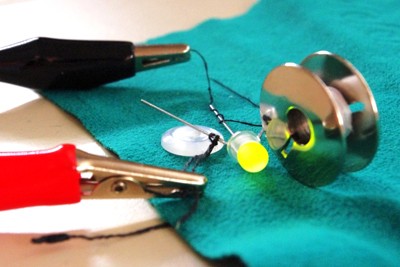
This organic electrochemical transistor was made with cotton fibers. The gate, drain and source in the device are made from cotton threads with conductive or semiconductive behavior induced
by using nanoparticle-based coatings.
Smarter, more functional clothing incorporating electronics may be possible in the near future, according to a study co-authored by Cornell fiber scientist Juan Hinestroza. Hinestroza, associate professor of fiber science, was part of an international team that developed transistors using natural cotton fibers. "Creating transistors from cotton fibers brings a new perspective to the seamless integration of electronics and textiles, enabling the creation of wearable electronic devices," Hinestroza said. The innovation represents a significant step forward because it lays the groundwork for creating even more complex devices, such as cotton-based circuits, Hinestroza said. This would allow fabrics to sense body temperature, automatically heat up or cool down, or track heart rate or blood pressure in high-risk patients, as well as to monitor physical effort of high-performance athletes. "Perhaps one day we can even build computers out of cotton fibers in a similar way as khipus - a recording device based on knots and used by the Inca empire in Peru," Hinestroza added. The research is published online Sept.
TO READ THIS ARTICLE, CREATE YOUR ACCOUNT
And extend your reading, free of charge and with no commitment.