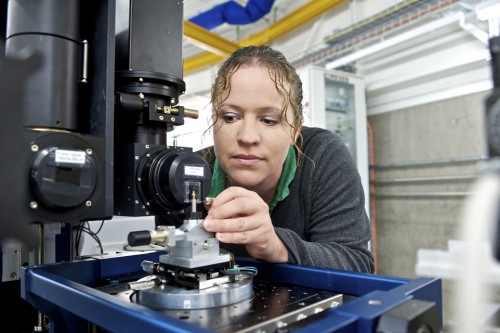
Julie Fife mounting a sample at the tomography beamline TOMCAT at the Swiss Light Source SLS of the Paul Scherrer Institute. (PSI/M.Fischer)
Many important materials are composed of several phases - regions that differ in structure or chemical composition. When such a material is heated, atoms move from one phase to another, which changes the distribution of the phases - and thus, the properties of the material. Researchers from Northwestern University in the USA, the Paul Scherrer Institute, and Risø National Laboratory for Sustainable Energy in Denmark have now shown that for an important case, there is a general law describing this process that is valid for all classes of materials - including metals and polymers. It's a problem that materials scientists have considered for years: how does a material composed of more than one phase evolve when heated to a temperature that will allow atoms to move? A phase is a region of a material that has a unique composition or atomic structure. For instance, ice (crystalline) and water (liquid) are two different phases. In many cases, a rod-like phase embedded in another will break up into smaller domains, which results in significant changes in the properties of the material. For example, imagine that a stream of water coming out of a faucet is the rod-like phase and it subsequently breaks up into droplets when, for example, flow pressure is decreased or distance from the faucet is increased. Now, researchers at Northwestern University in the USA, together with collaborators from Risø National Laboratory for Sustainable Energy in Denmark and the Swiss Light Source at the Paul Scherrer Institut in Switzerland have answered two important questions about this break-up process: How does it happen, and how long does it take?
TO READ THIS ARTICLE, CREATE YOUR ACCOUNT
And extend your reading, free of charge and with no commitment.