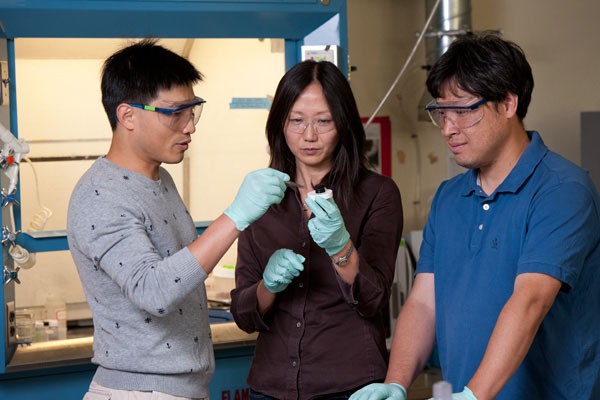
Postdoctoral fellow Guihua Yu, Associate Zhenan Bao and visiting scholar Ligia Pan examine the hydrogel made in the Bao lab.
The Jell-O-like material, from the labs of Stanford professors Yi Cui and Zhenan Bao, may have applications in areas as widespread as energy storage, medical sensors and biofuel cells. Stanford researchers have invented an electrically conductive gel that is quick and easy to make, can be patterned onto surfaces with an inkjet printer and demonstrates unprecedented electrical performance. The material, created by Stanford chemical engineering Associate Professor Zhenan Bao , materials science and engineering Associate Professor Yi Cui and members of their labs, is a kind of conducting hydrogel - a jelly that feels and behaves like biological tissues, but conducts electricity like a metal or semiconductor. That combination of characteristics holds enormous promise for biological sensors and futuristic energy storage devices, but has proven difficult to manufacture until now. The research appears this month in the journal PNAS. Printing Jell-O. Bao and Cui made the gel by binding long chains of the organic compound aniline together with phytic acid, found naturally in plant tissues.
TO READ THIS ARTICLE, CREATE YOUR ACCOUNT
And extend your reading, free of charge and with no commitment.