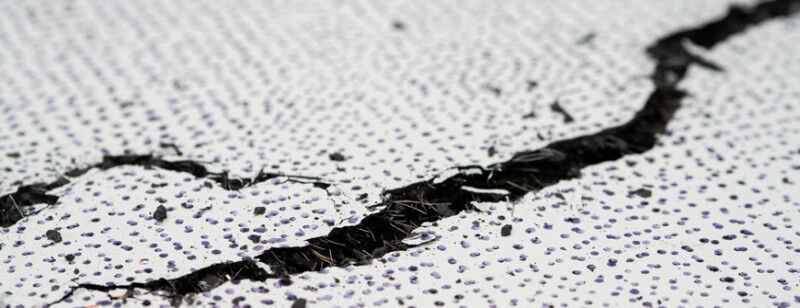
Many bridges in Switzerland were built before the 1980s - and are therefore approaching the end of their service life. researchers are now developing a novel strengthening system to retrofit damaged reinforced concrete bridges. For the first time, they have combined ultra-high-performance fiber-reinforced concrete with memory steel, which attempts to contract after being heated, therefore prestressing concrete structures.
Today, bridges are being strengthened with an additional layer of ultra-high-performance fiber-reinforced concrete (UHPFRC). This high-strength concrete is applied directly on the deck slabs and is particularly dense and resistant to water. Conventional reinforcing steel is embedded in it to increase its load-bearing capacity.
An Empa team led by researcher Angela Sequeira Lemos, working with Christoph Czaderski in the "Structural Engineering" lab has now gone one step further: They are replacing conventional steel reinforcement with iron-based shape memory alloy (Fe-SMA) bars - a "smart" material that can remember its original shape. After installation, the bars are heated to around 200°C. As they attempt to contract but are restrained by the concrete, internal stresses develop. These internal forces can close cracks, lift deformed elements, and extend the service life of a bridge - without the need for complex tensioning devices. "The beauty of this strengthening system is its simplicity," says Sequeira Lemos. "You anchor the bars, heat them up, and they do the rest themselves."
First, the Empa team investigated the interaction between shape memory steel and ultra-high-performance fiber-reinforced concrete, being combined here for the first time. The researchers examined how well the two materials bond to each other even after the shape memory steel was heated, and what forces could be transmitted.
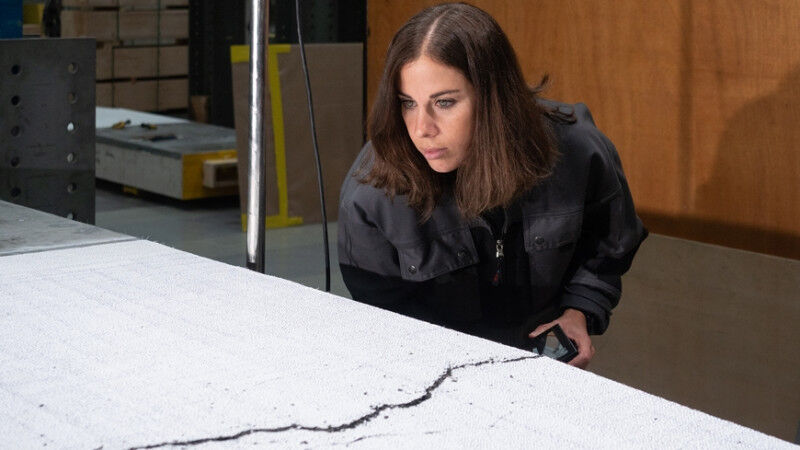
This was followed by large-scale tests at Empa’s construction hall with five concrete slabs, each five meters long. The slabs intended to represent cantilevered bridge decks. One slab remained unstrengthened, while the others were strengthened with a layer of ultra-high-performance fiber-reinforced concrete, combined either with conventional reinforcement or Fe-SMA bars. In order to simulate real-life conditions, the team first deliberately cracked the slabs before strengthening them - just as in a real bridge rehabilitation. After installation, the researchers heated the Fe-SMA bars, causing them to attempt to contract to their original shape and to prestress the reinforced concrete structure. Already during the activation, existing cracks were closed and remaining deformations completely disappeared.
Using state-of-the-art measurement technologies, the researchers continuously tracked deformations in the slabs. Digital cameras monitored cracks on the concrete surface, while tiny fiber optic sensors were embedded along the bars. "We use sensors that work similarly to fiber optic cables in telecommunications," explains the Empa researcher. "However, instead of sending encoded data through the fibers, we analyze the backscattered light. This allows us to see exactly how the bars are deforming."
The tests showed that both the conventional and the novel strengthening system with shape memory steel increased the load-bearing capacity of the unstrengthened slab by at least a factor of two. Under everyday conditions, however - such as those caused by normal road traffic - the combination of fiber-reinforced concrete and shape memory steel proved to be superior: It makes the bridge slab stiffer, delays permanent deformations, and can close existing cracks or slightly lift bent components. "We were able to show that our system not only works, but can actually revitalize existing bridges," says Sequeira Lemos.
The Fe-SMA (iron-based shape memory alloy) bars are manufactured like normal ribbed reinforcing bars and are delivered to the construction site on a pre-stretched condition. They are then positioned and anchored in the existing reinforced concrete structure, heated, and then covered with concrete. When heated, the steel "remembers" its original shape and tries to recover it. By being restricted to move, it develops internal forces instead which are transferred to the concrete via the anchor zones.
This shape memory effect is made possible by a special iron alloy that contains manganese, silicon, and chromium, among other elements. By initially stretching the bars, the atomic crystal structure is altered. When heated to around 200°C, the atomic structure reverts back. Since the steel is fixed in place, the resulting forces prestress the existing structure, closing existing cracks, and lifting deformed elements.