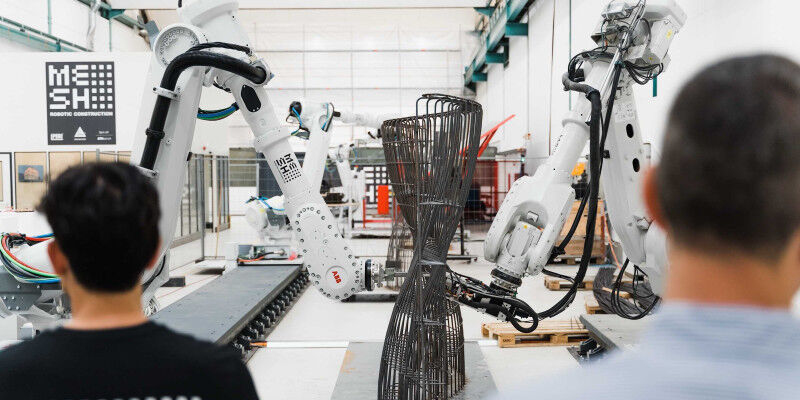
Reinforcement at the touch of a button
The core of MESH’s expertise lies in the software that processes the data and calculates the robot’s movements. It can generate the reinforcement cage of a free-form concrete wall at the touch of a button and send the data directly to the machine. The complexity of the shape is easy to handle thanks to the direct link between digital data and digital production. "Architects don’t normally have any connection to reinforcement," says Mirjan. "Now they can design with it, as the construction directly influences the shape."The MESH technology was used, among other things, to automatically place the reinforcement for the 3D-printed Tor Alva in Mulegns. The flagship project pushes the boundaries of digital fabrication and demonstrates its new formal possibilities. MESH is also focusing on the freedom of form at the Architecture Biennale in Venice, together with Gramazio Kohler Research and the artist Armin Linke. In the Arsenale, the team is presenting an installation consisting of three floating rings made of reinforcing steel, in the middle of which a humanoid robot dreams of the future of digital construction. "How digitalization will change architecture is still an open question," says research director Inés Ariza, who is responsible for the project.
For variety, against labour shortages
Beyond the Biennale, the reality of construction is still different. "The demand for complex shapes is limited, even if they can save material thanks to optimization," says Mirjan. MESH has therefore expanded its business model. The spin-off also uses its robots to partially automate the use of conventional reinforcing bars. An automatic stirrup bender machine the size of a bus stands in a corner of the hall. The industry has been using the machine for some time to automatically bend and cut rebar. The robot now replaces the worker, who removes the differently shaped parts and stacks them carefully.In this way, the startup is counteracting the shortage of labor, especially for such physically demanding jobs. Automation also helps to ensure that individual construction remains affordable. "No two buildings are identical, and the reinforcement of every staircase is slightly different," says Mirjan. Digital solutions allow this diversity in construction to be maintained even as wages rise. The first MESH robots are being used by reinforcement manufacturers in Switzerland, to whom the spin-off rents out its technology.
Used in the Gotthard Road Tunnel
MESH also uses the robotic arm to identify reinforcing bars, control quality and improve logistics overall. The company has been awarded a major contract for the construction of the second Gotthard road tunnel. Robots knot the reinforcing bars for prefabricated concrete elements at the crossing points. With around 10,000 reinforcement cages, this requires mass production, in which automation can save time and money.MESH’s technology can be used in a variety of ways, from free-form projects to standard prefabrication. The start-up will continue its research and try to open up new business areas. "Special projects such as the Tor Alva or at the Biennale are important to further develop the technology and communicate it to the construction industry," says Mirjan. "Our innovations should find broad application and make a sustainable contribution to the industry."
ETH spin-offs
Over 615 spin-offs have been licensed at ETH Zurich since 1973. The ETH Entrepreneurship group assists them with founding a company and accompanies start-ups on their journey to success.Find out more about ETH Entrepreneurship