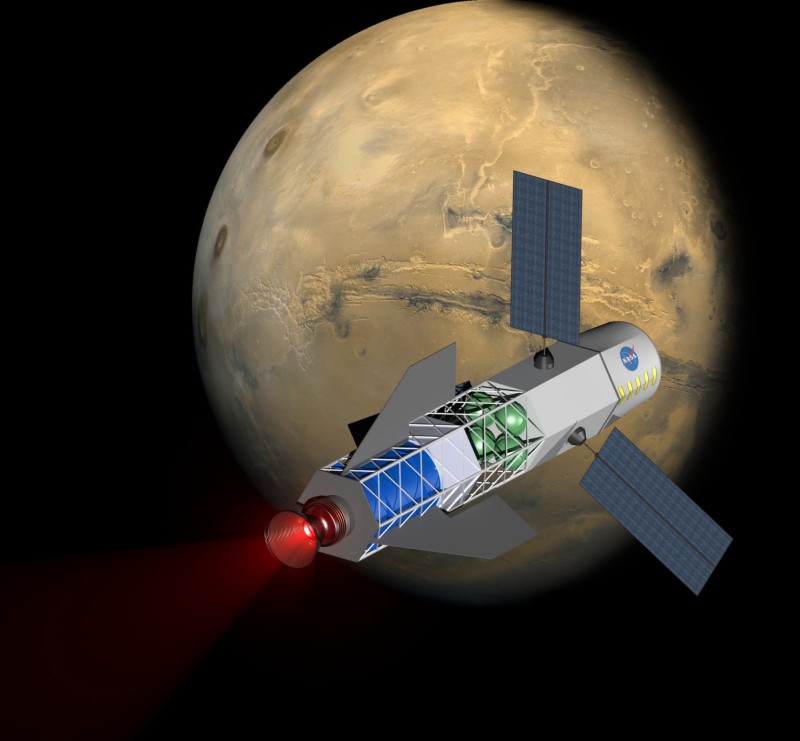
University of Washington, MSNW A concept image of a spacecraft powered by a fusion-driven rocket. In this image, the crew would be in the forward-most chamber. Solar panels on the sides would collect energy to initiate the process that creates fusion.
Human travel to Mars has long been the unachievable dangling carrot for space programs. Now, astronauts could be a step closer to our nearest planetary neighbor through a unique manipulation of nuclear fusion, the same energy that powers the sun and stars. University of Washington researchers and scientists at a Redmond-based space-propulsion company are building components of a fusion-powered rocket aimed to clear many of the hurdles that block deep space travel, including long times in transit, exorbitant costs and health risks. "Using existing rocket fuels, it's nearly impossible for humans to explore much beyond Earth,” said lead researcher John Slough , a UW research associate professor of aeronautics and astronautics. "We are hoping to give us a much more powerful source of energy in space that could eventually lead to making interplanetary travel commonplace. The project is funded through NASA's Innovative Advanced Concepts Program. Last month at a symposium , Slough and his team from MSNW , of which he is president, presented their mission analysis for a trip to Mars, along with detailed computer modeling and initial experimental results.
TO READ THIS ARTICLE, CREATE YOUR ACCOUNT
And extend your reading, free of charge and with no commitment.