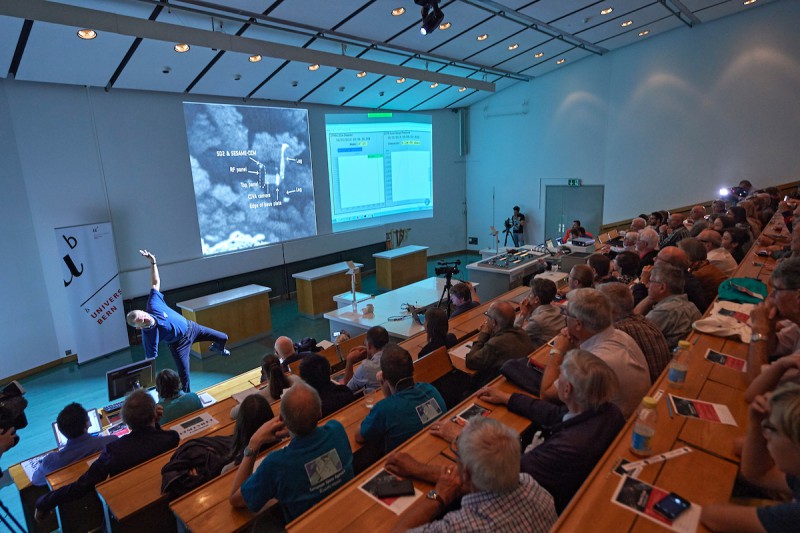
Nicolas Thomas of the Center for Space and Habitability (CSH) demonstrated how Rosetta’s Lander «Philae» is now lying on comet 67/P. The data of ROSINA sent during the descent was shown on the right. Photo: UniBE / Adrian Moser.
Rosetta's mission is over: After the last signal at 13:20, the spacecraft was crash-landed on comet Churyumov-Gerasimenko, with the ROSINA instrument from Bern taking measurements right until the very end. At the University of Bern, hundreds of people watched with interest as they followed the end of one of the most successful missions of the European Space Agency (ESA) live. Rosetta's mission took twelve years including notable firsts like the first orbit of a comet (and for 2 years no less) and, for the first time placing a lander on a comet surface. The Rosetta spacecraft has already made history. The spectacular mission has now come to an end, with Rosetta undergoing a controlled crash on "its" comet. As the comet moves away from the sun, the energy available to the solar-powered spacecraft was decreasing. Consequently, ESA decided to crash-land the spacecraft on the comet.
TO READ THIS ARTICLE, CREATE YOUR ACCOUNT
And extend your reading, free of charge and with no commitment.