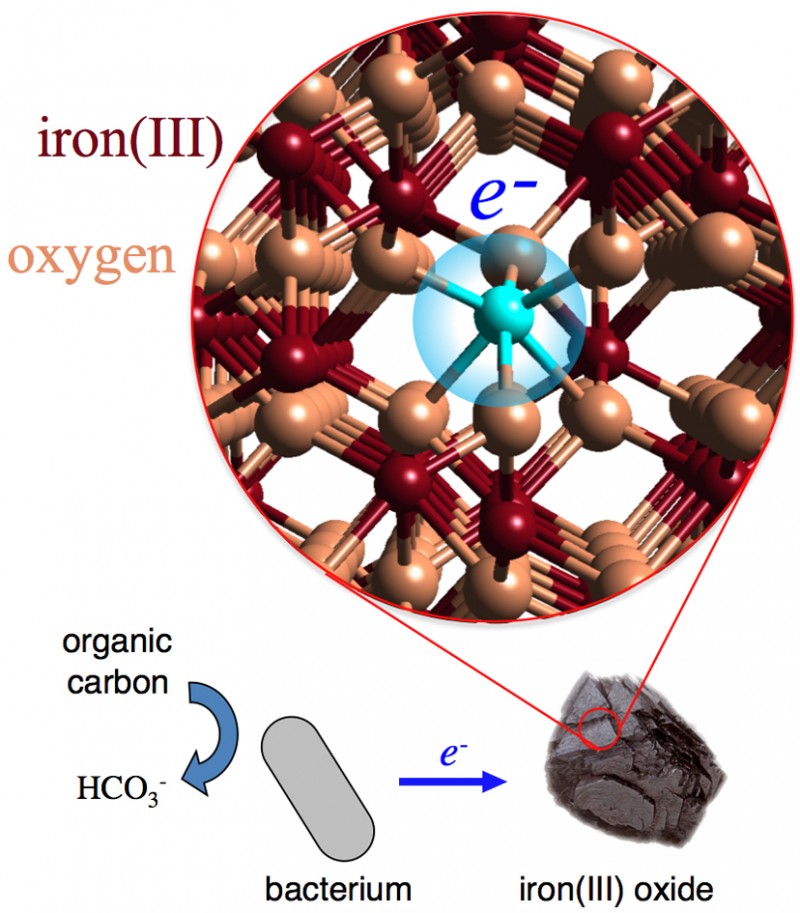
Iron oxide (rust) is a poor electrical conductor, but electrons in iron oxide can use thermal energy to hop from one iron atom to another. A Berkeley Lab experiment has now revealed exactly what happens to electrons after being transferred to an iron oxide particle. (Image courtesy of Benjamin Gilbert, Berkeley Lab)
Rust - iron oxide - is a poor conductor of electricity, which is why an electronic device with a rusted battery usually won't work. Despite this poor conductivity, an electron transferred to a particle of rust will use thermal energy to continually move or "hop" from one atom of iron to the next. Electron mobility in iron oxide can hold huge significance for a broad range of environment- and energy-related reactions, including reactions pertaining to uranium in groundwater and reactions pertaining to low-cost solar energy devices. Predicting the impact of electron-hopping on iron oxide reactions has been problematic in the past, but now, for the first time, a multi-institutional team of researchers, led by scientists at the U.S. Department of Energy (DOE)'s Lawrence Berkeley National Laboratory (Berkeley Lab) have directly observed what happens to electrons after they have been transferred to an iron oxide particle. "We believe this work is the starting point for a new area of time-resolved geochemistry that seeks to understand chemical reaction mechanisms by making various kinds of movies that depict in real time how atoms and electrons move during reactions," says Benjamin Gilbert, a geochemist with Berkeley Lab's Earth Sciences Division and a co-founder of the Berkeley Nanogeoscience Center who led this research. "Using ultrafast pump-probe X-ray spectroscopy, we were able to measure the rates at which electrons are transported through spontaneous iron-to-iron hops in redox-active iron oxides.
TO READ THIS ARTICLE, CREATE YOUR ACCOUNT
And extend your reading, free of charge and with no commitment.