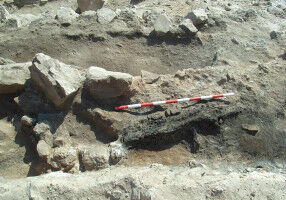
Scarlet Macaws Point to Early Complexity at Chaco Canyon
UNIVERSITY PARK, Pa. Carbon 14 dating of scarlet macaw remains indicates that interaction between Pueblo Bonito in Chaco Canyon, New Mexico, and Mesoamerica began more than 100 years earlier than previously thought, according to a team of archaeologists. "There is still lots to learn from Chaco Canyon," said Douglas J. Kennett , professor of environmental archaeology, Penn State. "Past dating has been too reliant on tree-ring dates, so we are going back into the collections and targeting objects like the scarlet macaws that can be radiocarbon dated." Excavations at Chaco Canyon began in the late 1800s, and by the early 1900s, thousands of artifacts had been shipped back east, many to the American Museum of Natural History in New York City. The researchers sampled scarlet macaws from these archives. They report their results in today's (June 22) online issue of Proceedings of the National Academy of Sciences. Built in stages, Pueblo Bonito's start date, taken from tree ring dates and pottery assemblages, is thought to be in the ninth century, but the pueblo and other structures in the canyon at that time were very small and architecturally unassuming.