Message from
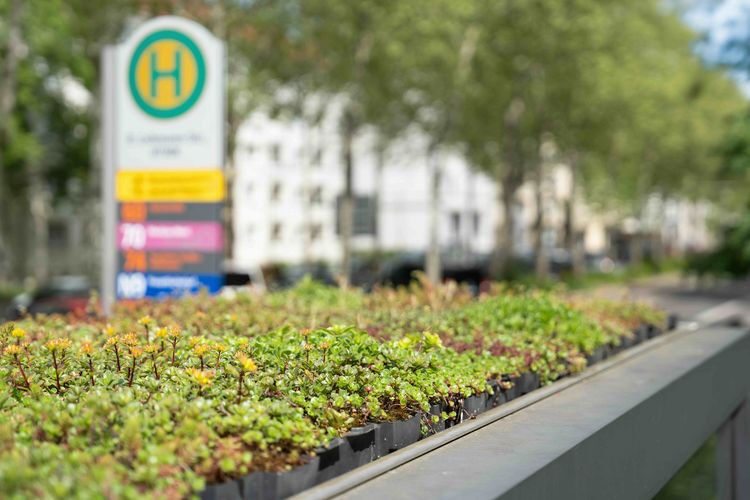
In an educational project at HTWK Leipzig, 10th grade students in Leipzig are collecting environmental data on the green roofs of bus stops and developing a real laboratory with citizen science approaches - in cooperation with the City of Leipzig and the Botanical Garden of Leipzig University.
How does green roofs affect the climate and biodiversity? And how can citizens make their own contributions to sustainable urban development? In the new educational project "FaGULab - Fahrgastunterstände Leipzig Reallabor", pupils from the 10th grade onwards carry out measurement campaigns on selected Leipzig passenger shelters with and without green roofs. Using modern sensor technology, they collect environmental and biodiversity data and analyze their effect on the microclimate in urban areas.
Real-world laboratory and citizen science
At the same time, the participants are developing a real-world laboratory that will subsequently be opened up to broader social participation. The aim is to develop site-appropriate greening concepts together with experts and interested parties, discuss them in the real-world laboratory and test them in practice.
The project sees itself as a transformative educational format with influences from education in the so-called "MINT" subjects of mathematics, computer science, natural sciences and technology, environmental education and education for sustainable development. It promotes research-based learning, interdisciplinary collaboration and active engagement with ecological and social issues. FaGULab is implemented under the leadership of the Leipzig University of Applied Sciences (HTWK Leipzig) and in cooperation with the Botanical Teaching Garden in the School Biology Center of the City of Leipzig and the Botanical Garden of the University of Leipzig. The project is part of the "Transformative Education for Sustainable Development" funding initiative of the German Federal Environmental Foundation (DBU) and has been supported with around 250,000 euros for three years since March 2025. In the future, the greening proposals developed will be incorporated into urban planning processes
planning processes.
Inspiring enthusiasm for research
FaGULab shows how education, participation and urban development can work together - in a practical, multi-perspective way and with a view to a sustainable future. The project receives important support from other associated partners: the Helmholtz Center for Environmental Research (UFZ) - Department of Systemic Environmental Biotechnology and the Office for Environmental Protection of the City of Leipzig. In addition, numerous participants from the Leipzig Green Roof Think Tank - a network of administration, research, education and business - are supporting the project.
- "FaGULab brings young people into action - with real data, real questions and real effects," says Mathias Rudolph, project manager at HTWK Leipzig (Faculty of Engineering). "They not only learn STEM basics, but also experience how their work contributes to concrete solutions for our city."
- Rolf Engelmann, Transfer Coordinator of the Botanical Garden at Leipzig University, emphasizes: "We are creating learning spaces in the middle of the city - lively interfaces between biodiversity, education and participation."
- Sebastian Hänsel, Scientific and Educational Director at the Leipzig School Biology Center, emphasizes: ,,FaGULab picks up pupils from very different realities of life - and creates opportunities for them to become active themselves. They experience that their knowledge counts, that their questions are relevant and that it is possible to help shape things - this is exactly what we need in education for sustainable development."
- "Green islands in the city have a cooling effect on hot days and promote biodiversity," says Melanie Vogelpohl, DBU specialist for STEM education and sustainability assessment. "In addition to supporting research and administration, those involved are also helping to shape the future. This can be an incentive for a more sustainable way of life and economy."