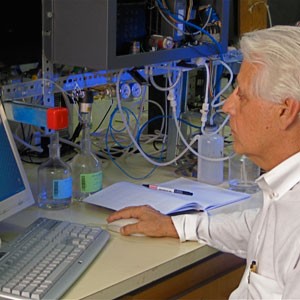
Frank Millero, professor of Marine and Atmospheric Chemistry at the University of Miami’s Rosenstiel School of Marine and Atmospheric Science.
July 31, 2009 — Miami — This summer, one of the world's leading ocean science bodies, the United Nations Educational, Scientific and Cultural Organization's (UNESCO?s) and Intergovernmental Oceanographic Commission (IOC) adopted the new international thermodynamic equation of state for seawater called TEOS-10. A complex, dynamic mixture of dissolved minerals, salts, and organic material, seawater has historically presented difficulties in terms of determining its physical chemical properties. For 30 years, climate models have relied on a series of equations called the International Equation of State of Seawater - or EOS-80, which uses the Practical Salinity Scale of seawater. This equation was used to determine the pressure, volume, temperature proprieties of seawater. Other thermodynamic properties, including heat capacity, enthalpy and sound speed were obtained using separate equations. The Scientific Committee on Oceanic Research (SCOR) established a working group to look at the thermodynamic properties of seawater in 2005. The team included scientists from the Leibniz-Institut für Ostseeforschung in Warnemünde (Germany), University of Miami (USA), Desert Research Institute - Nevada System of Higher Education (USA), Bedford Institute of Oceanography (Canada), the Commonwealth Scientific and Research Organization (Australia), the National Oceanographic Centre (United Kingdom) and the Institute of Marine Geology and Chemistry (China).
TO READ THIS ARTICLE, CREATE YOUR ACCOUNT
And extend your reading, free of charge and with no commitment.