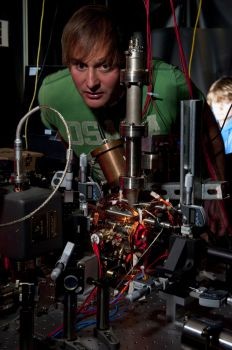
Dr Winfried Hensinger and the vacuum system, along with lasers and optics, which the Sussex team used in their discovery
Scientists take a quieter step closer to first practical quantum computer. Scientists working to produce the world's fastest, most powerful computers have moved a step closer to creating a practical prototype using microwaves - by shielding the atoms driving this new generation of computers from the harmful effects of noise. Microwaves are already used in smart phone technology, but scientists are now looking at how they can harness microwaves so that atomic particles can be used to store and process data on a new type of computer called a quantum computer. The ability to store and process huge amounts of data in a quantum way (on an atomic scale) would revolutionise computing, making it possible to carry out massive calculations and enabling computers to understand chemical reactions, create new medicines and carry out seemingly impossible simulations, such as the creation of our universe. To build a quantum computer, scientists trap electrically charged atoms (ions) and control them so that they can be harnessed to form the "atomic highways" that would build the computer network. The first small-scale ion trap quantum computers have already been built using lasers to carry out calculations within the 'quantum processor', but the number of lasers needed to make a large-scale quantum computer would make this a substantial engineering challenge. A new generation of quantum computers is now being devised utilising microwaves instead, which are easier to use and which should bring the construction of a large-scale ion-trap quantum-information processor much closer.
TO READ THIS ARTICLE, CREATE YOUR ACCOUNT
And extend your reading, free of charge and with no commitment.