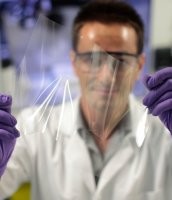
Scientists at Imperial are being backed by government to put the UK at the forefront of a high-tech global electronics industry
Scientists are being backed by government to put the UK at the forefront of a growing global high-tech electronics industry. Using low cost and high efficiency printing techniques, components such as simple displays, power sources, sensors and electronic circuits could be printed in large numbers onto a single giant sheet, in a similar way to how postage stamps are produced. In the future such technologies could be used to make engaging electronic greetings cards, toys and games, smart packaging and anti-counterfeit devices. They could also be integrated with current medical devices, electronic displays, low-energy LED lighting and electricity generating solar panels. New public funding will help to develop economically viable processes for manufacturing these future components and integrated electronic systems on an industrial scale. The Engineering and Physical Sciences Research Council (EPSRC), which announced the funding last week estimates that the market value of such products could exceed £16 billion in just a few years. Imperial College London researchers - Natalie Stingelin (Materials), and Paul Stavrinou, Professor Thomas Anthopoulos and Donal Bradley (all Physics) - from the Centre for Plastic Electronics are part of a consortium of four universities that will contribute to the EPSRC Centre for Innovative Manufacturing in Large Area Electronics, one of four new centres funded under the scheme.
TO READ THIS ARTICLE, CREATE YOUR ACCOUNT
And extend your reading, free of charge and with no commitment.