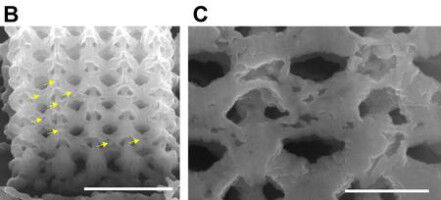
Cross section of a Linum "Drakkar” stem with a 26-day-old wound parallel to the fibres
Scientists have studied how the flax plant heals itself after it has been wounded. They measured changes in the plant's mechanical properties, like stiffness and damping, and examined the plant's self-repair mechanisms. Because natural fibers are being increasingly used to make composite materials, understanding how such mechanisms work can help scientists develop self-healing materials with better performance, drawing on methods inspired by nature. The research was recently published in PLOS ONE. Imagine car paint that can automatically repair itself after a scratch, or a corrosion-resistant coating that can automatically restore itself after being chipped off. These are just two of the promising new applications for self-healing materials - although numerous obstacles remain. "Each type of material poses a different challenge," says Véronique Michaud, one of the study's authors and head of the LPAC at EPFL. "Some materials can already regenerate thanks to a system of liquids inside them. If the material is scratched, the liquid flows out and reacts with the surrounding air, for example, to fill in the scratch. It's similar to how your blood coagulates if you cut your finger." But other materials are more complicated, and progress is still at the laboratory stage. That's especially true for composite materials, which are used in aircraft and sporting equipment - and are the focus of the scientists' work. Changes in plants' mechanical properties
TO READ THIS ARTICLE, CREATE YOUR ACCOUNT
And extend your reading, free of charge and with no commitment.
Your Benefits
- Access to all content
- Receive newsmails for news and jobs
- Post ads