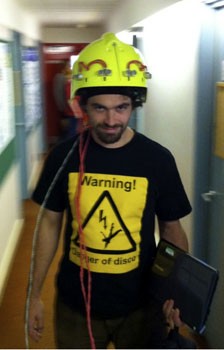
Sensory fire helmet in action
A specially-adapted 'tactile helmet', developed by researchers at the University of Sheffield, could provide fire-fighters operating in challenging conditions with vital clues about their surroundings. The helmet is fitted with a number of ultrasound sensors that are used to detect the distances between the helmet and nearby walls or other obstacles. These signals are transmitted to vibration pads that are attached to the inside of the helmet, touching the wearer's forehead. Rescue workers, such as fire-fighters, who might be working in dark conditions or in buildings filled with smoke, will be able to use the signals to find walls and other obstacles that could help guide them through unfamiliar environments. It is anticipated that a lightweight version of the technology could also be useful to people with visual impairments, acting as an additional 'sense' to guide users or to help them avoid hazards. Invented by a team of researchers at the Sheffield Centre for Robotics (SCentRo), the helmet was inspired by research into tactile sensing in rodents, whose whiskers give early warning of potential hazards. Professor Tony Prescott of the University of Sheffield and director of SCentRo, said: "When a firefighter is responding to an emergency situation he will be using his eyes and ears to make sense of his environment, trying to make out objects in a smoke filled room, for example, or straining to hear sounds from people who might need rescuing.
TO READ THIS ARTICLE, CREATE YOUR ACCOUNT
And extend your reading, free of charge and with no commitment.