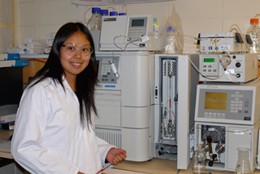
PhD student Lucy Cao from the ARC Centre of Excellence for Free Radical Chemistry
Research into an enzyme that produces a hormone released after sex has inspired ANU chemists to create new treatments for small-cell lung cancer. Led by Professor Chris Easton and PhD student Ms Lucy Cao from the ARC Centre of Excellence for Free Radical Chemistry and Biotechnology at ANU, the team are working to reduce the number of small-cell lung cancer deaths by building new drugs that target the biology underlying the disease. Their work has been published in the latest edition of The Royal Society Chemistry journal, Medicinal Chemistry . 'Given that one in every 28 Australians are diagnosed with lung cancer and it is the most common cause of cancer death, there is a real need to develop new pharmaceuticals to treat this disease. Although it is still early days our results are very promising,' said Professor Easton. The team are investigating an enzyme, known as PAM, which activates a number of important peptide hormones. These include calcitonin, which promotes cell proliferation, and oxytocin, dubbed the 'love hormone', as it produces feelings of contentment following orgasm.
TO READ THIS ARTICLE, CREATE YOUR ACCOUNT
And extend your reading, free of charge and with no commitment.