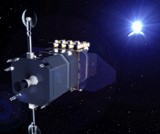
The Solar Dynamics Observatory Spacecraft. Credit: NASA
Sheffield scientists celebrated the launch of NASA´s latest space mission from Cape Canaveral, Florida yesterday (Thursday 11 February 2010). The Solar Dynamics Observatory (SDO) will deliver high resolution images of the Sun ten times better than the average High-Definition (HD) television to help scientists understand more about the Sun and its disruptive influence on services like communications systems on Earth. Scientists from the UK, including those at the University of Sheffield, have provided essential expertise and technology to the mission. SDO is the first mission in NASA´s Living with a Star (LWS) programme. Its unique orbit will allow high resolution images to be recorded every three quarters of a second, providing in-depth information about the Sun´s complex magnetic fields and space weather generated by solar flares and violent eruptions from the Sun´s atmosphere known as Coronal Mass Ejections (CMEs). Professor Richard Harrison, STFC Rutherford Appleton Laboratory (RAL) scientist, said: "A CME can carry a billion tonnes of solar material into space at over a million kilometres per hour. Such events can expose astronauts to deadly particle doses, can disable satellites, cause power grid failures on Earth and disrupt communications.
TO READ THIS ARTICLE, CREATE YOUR ACCOUNT
And extend your reading, free of charge and with no commitment.