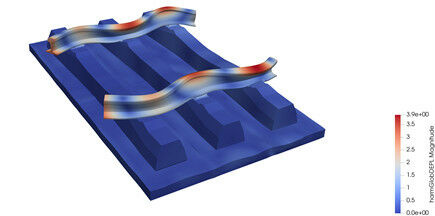
Simulation and Hardware: The graphic illustrates the deformation of the rail. Image: Empa
Simulation and Hardware: The graphic illustrates the deformation of the rail. Image: Empa - Noise barriers or improved wheel systems and brakes that are less noisy are not the only ways to reduce railway noise for close-by residents. An inconspicuous component under the tracks is a source of hope for a research team including scientists. Railway noise is unhealthy. Hundreds of millions of Swiss francs have already been invested in noise barriers, quieter braking systems and other measures with the goal to protect at least 80 percent of the Swiss population from emissions by the year 2025 - but because railway traffic will continue to increase, a lot remains to be done. To further reduce noise pollution, researchers at Empa and the Vaud School of Economics and Engineering, under the leadership of colleagues from EPFL, are relying on an inconspicuous component of the rail system: "rail pads" made of elastic plastic, which are inserted between the rails and concrete sleepers. They serve to protect the highly stressed track made of compacted ballast and concrete sleepers by allowing the rails to move just a tiny bit - like a guitar string that is pressed onto the fingerboard at several points at once.
TO READ THIS ARTICLE, CREATE YOUR ACCOUNT
And extend your reading, free of charge and with no commitment.