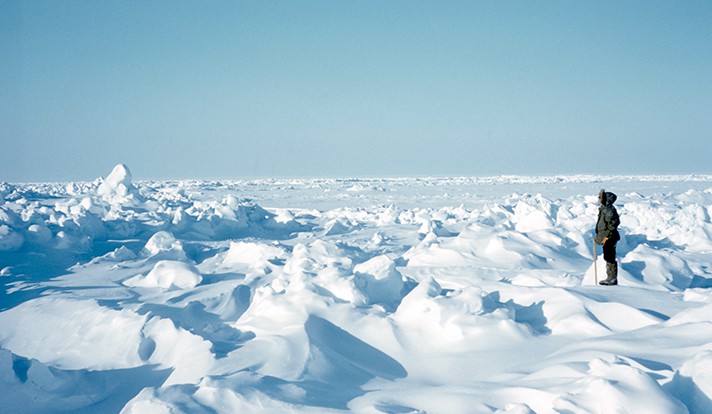
(Photo by Norbert Untersteiner, 1957)
Yale University scientists have answered a 40-year-old question about Arctic ice thickness by treating the ice floes of the frozen seas like colliding molecules in a fluid or gas. Although today's highly precise satellites do a fine job of measuring the area of sea ice, measuring the volume has always been a tricky business. The volume is reflected through the distribution of sea ice thickness - which is subject to a number of complex processes, such as growth, melting, ridging, rafting, and the formation of open water. For decades, scientists have been guided by a 1975 theory (by Thorndike et al.) that could not be completely tested, due to the unwieldy nature of sea ice thickness distribution. The theory relied upon a term that could not be related to the others, which represented the mechanical redistribution of ice thickness. As a result, the complete theory could not be mathematically tested. Enter Yale professor John Wettlaufer, inspired by the staff and students at the Geophysical Fluid Dynamics Summer Study Program at the Woods Hole Oceanographic Institution, in Massachusetts.
TO READ THIS ARTICLE, CREATE YOUR ACCOUNT
And extend your reading, free of charge and with no commitment.