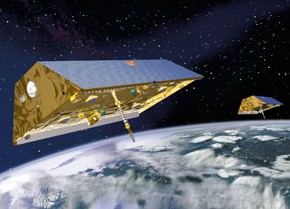
Image courtesy of NASA
A team of researchers from The Australian National University has been selected from a competitive field to participate in NASA's Gravity Recovery and Climate Experiment (GRACE) Science Team. The GRACE twin satellites, launched in March 2002, are making detailed measurements of the Earth's gravity field which will lead to discoveries about its natural systems that could have far-reaching benefits to society and the world's population. Through their project Ground validation and background models for GRACE data analysis, the ANU team will develop new analysis techniques to turn raw space observations into information about changes in water resources and melting rates of Antarctica and Greenland. Paul Tregoning, a geodesist from the Research School of Earth Sciences at ANU, said membership on space mission science teams was one of the ways that Australians could contribute to international efforts towards monitoring the state of the Earth through observing missions. "It's an exciting time to be a geodesist,” Tregoning said. "The only way that society and governments can know what is happening to the Earth is through global observations from satellite Earth-observing missions. "The GRACE mission is one of the main ways that melting of polar-regions is measured, and now Australia is formally part of the mission Science Team.
TO READ THIS ARTICLE, CREATE YOUR ACCOUNT
And extend your reading, free of charge and with no commitment.