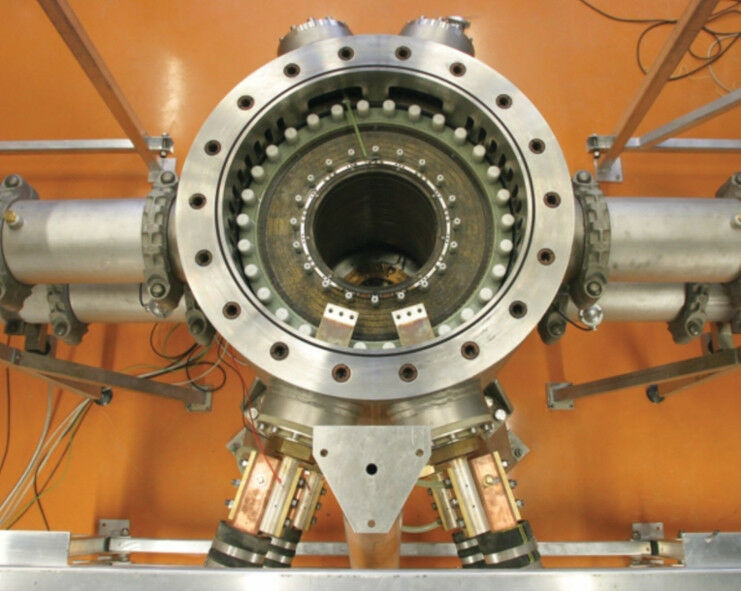
This 33 T Bitter magnet at the High Field Magnet Laboratory in Nijmegen, the Netherlands, is used to measure superconductors in very strong magnetic fields. (Image courtesy of Dick van Aalst, Radboud University, The Netherlands.)
This 33 T Bitter magnet at the High Field Magnet Laboratory in Nijmegen, the Netherlands, is used to measure superconductors in very strong magnetic fields. (Image courtesy of Dick van Aalst, Radboud University, The Netherlands. In a recent featured review written for Physics Today, Anne de Visser (UvA-IoP) explains how some very special materials can conduct electricity without any resistance - and behave even better when a magnetic field is turned on. Sometimes, materials are able to conduct electricity without any resistance whatsoever: superconductivity . Superconductors could in principle form a solution to many of the world's energy problems - but unfortunately, most superconducting materials only exhibit their special properties under very special circumstances. The temperature at which these materials operate is far below room temperature, or the applied pressure must be enormous. Moreover, the presence of external influences, such as a magnetic field, often also destroys the superconductivity effect.
TO READ THIS ARTICLE, CREATE YOUR ACCOUNT
And extend your reading, free of charge and with no commitment.