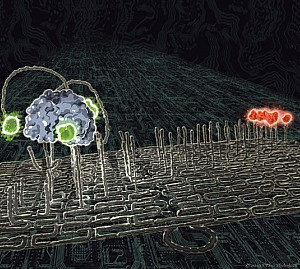
The latest installment in DNA nanotechnology has arrived: A molecular nanorobot dubbed a "spider" and labeled with green dyes traverses a substrate track built upon a DNA origami scaffold. It journeys towards its red-labeled goal by cleaving the visited substrates, thus exhibiting the characteristics of an autonomously moving, behavior-based robot at the molecular scale.
PASADENA, Calif.—A team of scientists from Columbia University, Arizona State University, the University of Michigan, and the California Institute of Technology (Caltech) have programmed an autonomous molecular "robot" made out of DNA to start, move, turn, and stop while following a DNA track. The latest installment in DNA nanotechnology has arrived: A molecular nanorobot dubbed a "spider" and labeled with green dyes traverses a substrate track built upon a DNA origami scaffold. It journeys towards its red-labeled goal by cleaving the visited substrates, thus exhibiting the characteristics of an autonomously moving, behavior-based robot at the molecular scale. The development could ultimately lead to molecular systems that might one day be used for medical therapeutic devices and molecular-scale reconfigurable robots—robots made of many simple units that can reposition or even rebuild themselves to accomplish different tasks. The traditional view of a robot is that it is "a machine that senses its environment, makes a decision, and then does something—it acts," says Erik Winfree, associate professor of computer science, computation and neural systems, and bioengineering at Caltech.
TO READ THIS ARTICLE, CREATE YOUR ACCOUNT
And extend your reading, free of charge and with no commitment.