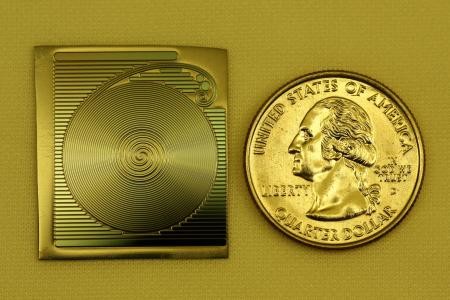
A photograph of the 1.2 meter spiral chip-based resonator developed at Caltech, shown next to a quarter to provide scale.
Researchers at Caltech developed the optical equivalent of a tuning fork-a chip-based device that could be important to electronics of the future. A group of researchers at the California Institute of Technology (Caltech) has created the optical equivalent of a tuning fork-a device that can help steady the electrical currents needed to power high-end electronics and stabilize the signals of high-quality lasers. The work marks the first time that such a device has been miniaturized to fit on a chip and may pave the way to improvements in high-speed , navigation, and remote sensing. "When you're tuning a piano, a tuning fork gives a standardized pitch, or reference sound frequency; in optical resonators the 'pitch' corresponds to the color, or wavelength, of the light. Our device provides a consistent light frequency that improves both optical and electronic devices when it is used as a reference," says Kerry Vahala, Ted and Ginger Jenkins Professor of Information Science and Technology and Applied Physics. Vahala is also executive officer for applied physics and materials science and an author on A good tuning fork controls the release of its acoustical energy, ringing just one pitch at a particular sound frequency for a long time; this sustaining property is called the quality factor. Vahala and his colleagues transferred this concept to their optical resonator, focusing on the optical quality factor and other elements that affect frequency stability.
TO READ THIS ARTICLE, CREATE YOUR ACCOUNT
And extend your reading, free of charge and with no commitment.