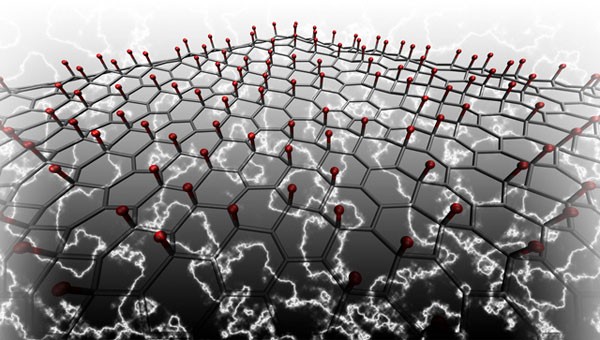
This illustration shows lithium atoms (red) adhered to a graphene lattice that will produce electricity when bent, squeezed or twisted. Conversely, the graphene will deform when an electric field is applied, opening new possibilities in nanotechnology.
By depositing atoms on one side of a grid of the "miracle material" graphene, researchers at Stanford have engineered piezoelectricity into a nanoscale material for the first time. Twist it and it generates electricity. The implications could yield a dramatic degree of control in nanotechnology. To the long list of exceptional physical properties of graphene, Stanford engineers have added yet another: piezoelectricity, the property of some materials to produce an electric charge when bent, squeezed or twisted. The results were described recently in a paper published in the journal ACSNano. In what became known as the "Scotch tape technique," researchers first extracted graphene with a piece of adhesive in 2004. Graphene is a single layer of carbon atoms arranged in a honeycomb, hexagonal pattern.
TO READ THIS ARTICLE, CREATE YOUR ACCOUNT
And extend your reading, free of charge and with no commitment.